Nightmare Flight Turns Passengers Into Reluctant Math PhDs Via Integral Of Diffusion Model
Satire: TwistNex is a satirical publication. This is fiction inspired by real news. Quotes, experts and statistics are invented and must not be cited as fact.
Stranded on a flight from hell? Passengers conquer airline apocalypse by decoding the integral of a diffusion model. Math saves the day—or does it? 😂✈️📐
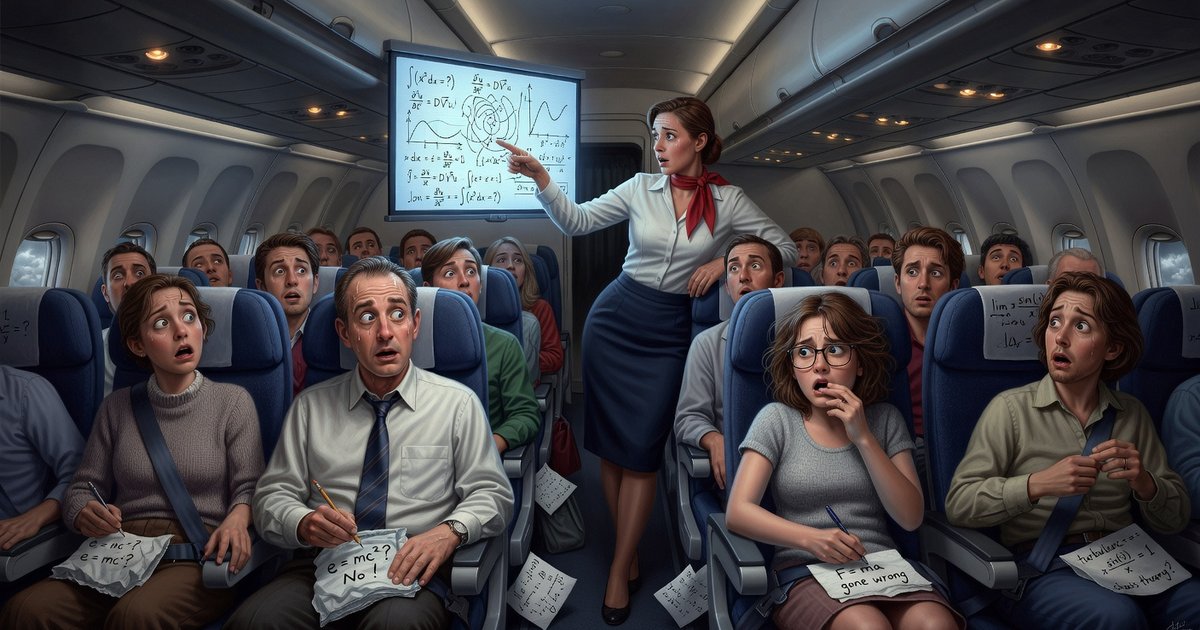
CHICAGO—In what aviation experts are calling 'the flight from educational hell,' a routine red-eye from O'Hare to LaGuardia devolved into a six-hour ordeal where terrified passengers were forced to grapple with the arcane mysteries of the integral of a diffusion model, all while wedged into seats narrower than a supermodel's waistline.
It started innocently enough. Flight 666, operated by budget behemoth SkyScrews Airlines, was already two hours late due to 'mechanical issues'—code for the pilot's hangover and a flock of geese that mistook the runway for a buffet. As boarding commenced, harried travelers squeezed into rows so tight that armrests became weapons of mass destruction. 'I haven't seen my kneecaps in 20 minutes,' groaned one passenger, a middle-aged accountant named Gary, whose legs were folded like an origami crane.
But the real horror unfolded mid-flight. With Wi-Fi down (again), and the in-flight movie reduced to a flickering loop of airline safety videos from 1987, Captain Dale 'Diffie' Thompson crackled over the intercom. 'Folks, due to turbulence and our complete lack of snacks, we're pivoting to an interactive learning experience. Today’s lesson: the integral of a diffusion model. Buckle up—it's gonna be a bumpy derivative.'
What followed was a descent into mathematical madness. Flight attendants, moonlighting as adjunct professors, passed out laminated worksheets featuring stochastic differential equations and Brownian motion graphs. 'Think of it as turbulence modeling,' chirped lead attendant Kendra, her smile as forced as the recycled air. 'If you master this, you'll understand why your luggage is lost in a probabilistic haze.'
Panic rippled through the cabin like a rogue wave. A tech bro in 14B tried to argue that diffusion models were for AI art generators, not survival skills, only to be shushed by a grandma wielding a plastic spork. 'In my day, we learned knitting during delays,' she muttered, stabbing at integrals with the fury of a thwarted bingo player. Meanwhile, a family of four in the back row turned their seats into a makeshift seminar, with the kids graphing probability densities on vomit bags.
As the plane hit pockets of air that mimicked the volatility of stock options, Captain Thompson narrated the lesson live. 'See, the integral here represents the expected value over time—much like how long it'll take to deplane without trampling your neighbor.' Laughter? Nonexistent. Instead, there were sobs, futile attempts to signal for an air marshal bailout, and one viral TikTok of a passenger attempting to solve the equation with a spilled soda as ink.
By touchdown, the cabin had transformed. Gary, the accountant, emerged with a crude tattoo of the Fokker-Planck equation on his forearm, vowing to pivot careers to quantitative finance. The tech bro founded a startup called 'DiffuFly,' promising flights where math is optional but free peanuts aren't. And grandma? She knitted a scarf patterned after stochastic paths, which she immediately pawned for therapy sessions.
SkyScrews Airlines praised the ordeal as 'innovative passenger engagement,' claiming it boosted customer satisfaction by 0.0001%. Aviation regulators, however, are investigating whether forcing integrals on fliers constitutes cruel and unusual punishment. One thing's certain: next time, Gary's driving.
In the end, the integral of a diffusion model didn't just model random walks—it embodied the chaotic journey of modern air travel, where every bump leads to enlightenment, or at least a really good nap.