Experts Warn Suboptimal Blinking During Sets Cuts Gains by 19 Percent
Satire: TwistNex is a satirical publication. This is fiction inspired by real news. Quotes, experts and statistics are invented and must not be cited as fact.
New research proves that missing your calibrated blink window during squats is basically throwing money on the floor.
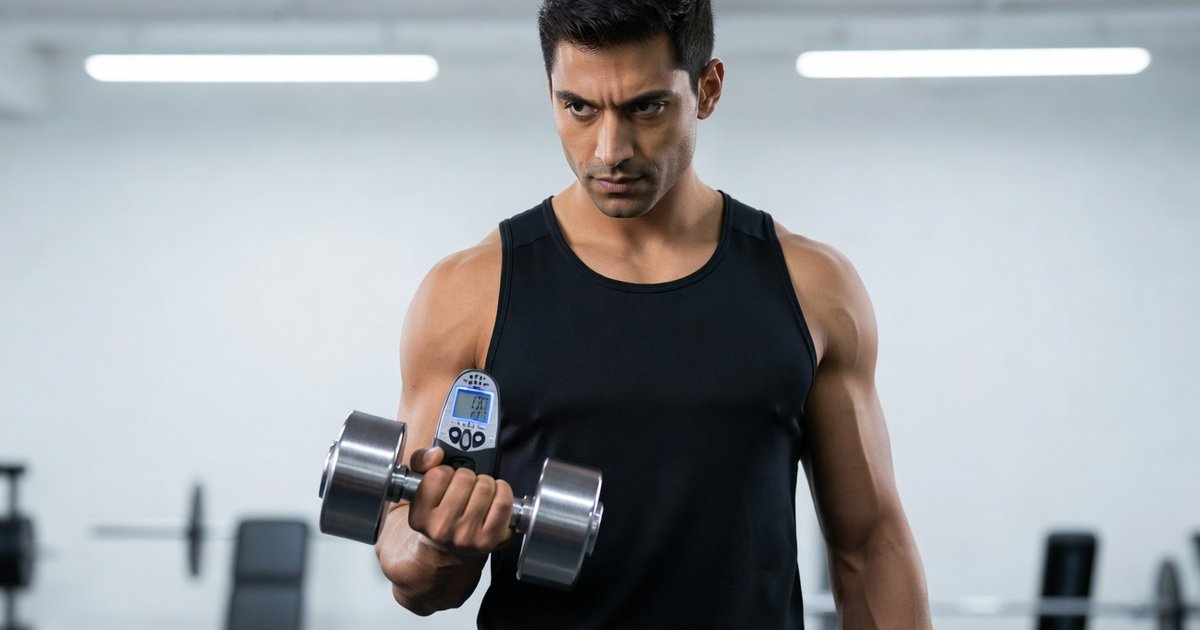
A longitudinal study released Tuesday by the National Bureau of Bodily Optimization concludes that lifters who fail to blink at precise 4.7-second intervals during resistance exercises experience a measurable 19 percent reduction in hypertrophy compared with those who maintain calibrated ocular rhythms.
Lead researcher Dr. Harlan Quist explained that each missed blink creates a micro-disruption in proprioceptive feedback loops. "The eye functions as a metronome for the central nervous system," Quist stated. "When that metronome drifts, motor-unit recruitment falls out of phase with mitochondrial signaling, and the entire session is effectively downgraded to maintenance level."
Participants in the optimal cohort were fitted with custom eyelid sensors that delivered haptic pulses when blink timing deviated by more than 300 milliseconds. Over twelve weeks these subjects recorded average increases of 2.8 centimeters in quadriceps circumference while control-group lifters, left to blink spontaneously, gained only 1.9 centimeters despite identical training volumes and macronutrient protocols.
Additional findings indicated that mental visualization must be restricted to spreadsheet-style cell references rather than abstract imagery. Subjects instructed to picture each repetition as "Cell B17 increasing by one unit" outperformed those who imagined abstract fire or exploding stars by a margin of 11.4 percent on one-rep-max testing.
Quist cautioned against combining optimized blinking with non-calibrated breathing patterns. "If inhalation exceeds 2.3 seconds, the blink cycle desynchronizes regardless of eyelid discipline," he said. Recommended protocols now include a synchronized 2.3-second inhale, 1.9-second hold, and 3.1-second exhale, with the final exhale timed to coincide with the eccentric portion of the lift.
The institute has begun licensing proprietary metronome apps that overlay both blink and breath cues onto gym mirrors. Early adopters report that conversations with training partners must be limited to pre-approved efficiency statements lasting no longer than 4.2 seconds to avoid cognitive drift.
Quist emphasized that the findings apply equally to recreational and competitive populations. "Anyone attempting to exist above baseline metabolic efficiency without these temporal anchors is simply performing expensive fidgeting," he said.