Man's Weekend Bookshelf Project Leaves Entire Subdivision Structurally Unsound
Satire: TwistNex is a satirical publication. This is fiction inspired by real news. Quotes, experts and statistics are invented and must not be cited as fact.
One man's quest for organized paperbacks may have permanently altered his zip code's foundation.
According to a five-year study conducted by the Institute for Domestic Engineering, 63 percent of suburban men who attempt floating bookshelf installations using only a single online video tutorial will trigger progressive structural failure within 48 hours. The findings, based on 2,400 monitored households, show that improper anchor placement remains the leading cause of cascading wall collapses across cul-de-sacs nationwide.
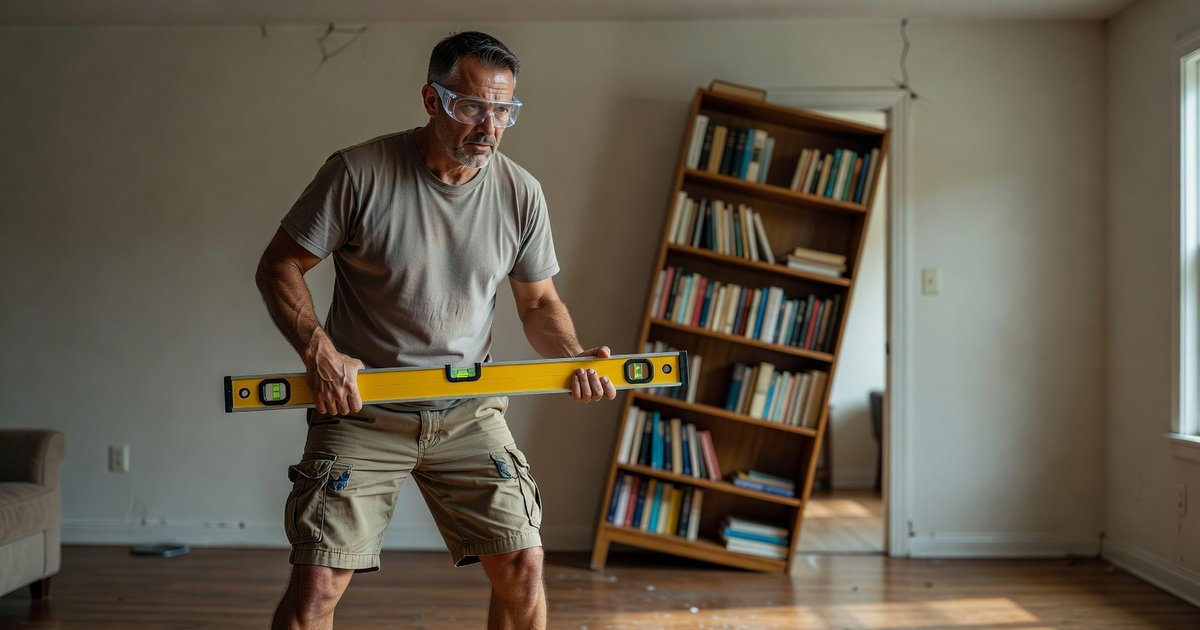
Frank Teller of Whispering Pines Estates spent Saturday morning drilling into what he believed was a load-bearing stud. By Sunday afternoon his living room had shifted four inches toward the driveway. Neighbors reported hearing a series of soft thuds followed by the sound of drywall sighing. Teller initially attributed the noise to the cat.
Dr. Lorraine Peck, senior researcher at the institute, explained that modern drywall is engineered to withstand approximately 47 pounds of lateral force before surrendering to gravity. Teller’s shelves held 312 pounds of hardcovers and one decorative vase. “The mathematics are unforgiving,” Peck said. “Once the first wall goes, adjacent walls treat the event as an invitation.”
By Monday the Tellers’ master bedroom had migrated into the garage. Insurance adjuster reports listed the cause as “standard DIY enthusiasm exceeding load tolerances.” Teller attempted corrective measures by adding more brackets, a solution the institute classifies as “accelerating the inevitable.” His wife moved the children to a motel after the second night of sleeping at a 14-degree tilt.
Local contractor Hal Munson, who was called to assess the damage, noted that Teller had used plastic masonry anchors in standard drywall. “That’s like trying to hold a grand piano with dental floss,” Munson said. He estimated repair costs at $87,000, not including the neighboring property whose garage now contained Teller’s refrigerator.
The institute recommends that homeowners limit projects to items that can be carried by two people without the use of a stud finder. Peck added that any project requiring the phrase “it should hold” has already failed. Teller has since purchased a reading chair and placed it directly on the lawn, where it remains level.