Study: 19 Minutes of Intersection Debates Strengthen Bonds More Than GPS
Satire: TwistNex is a satirical publication. This is fiction inspired by real news. Quotes, experts and statistics are invented and must not be cited as fact.
New data confirms arguing over exits builds stronger relationships than actually arriving on time.
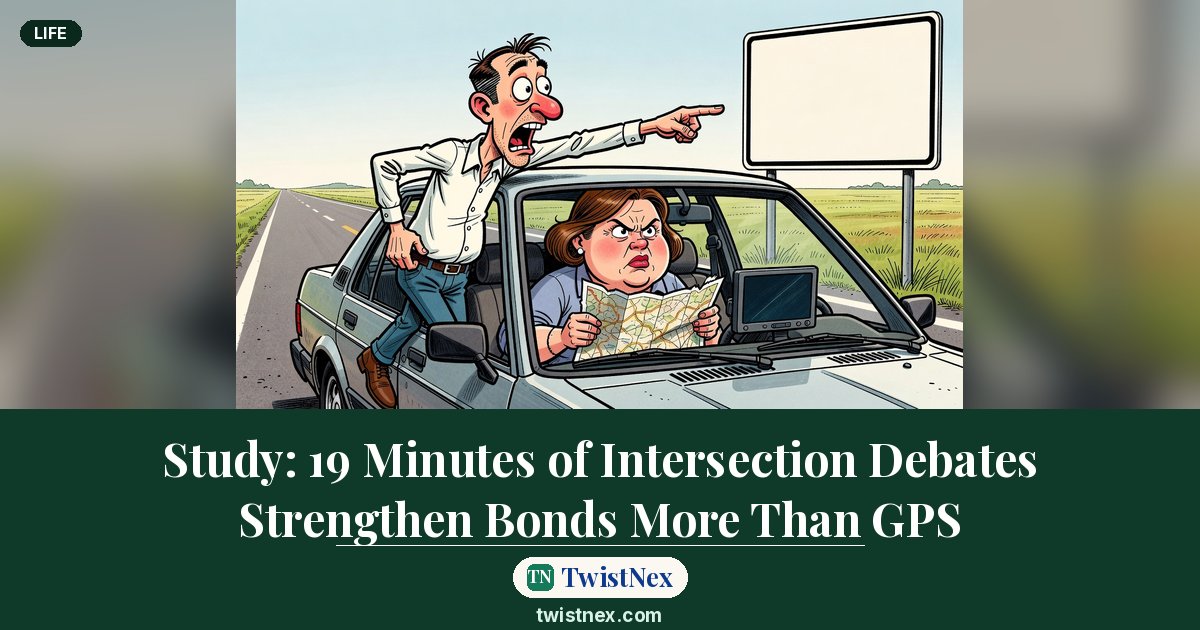
A landmark study released Tuesday by the Institute for Marital Navigation Studies found that couples who deliberately avoid GPS applications experience 34 percent more sustained arguments per road trip than those who rely on automated routing. Researchers tracked 1,200 participants across 47 states and concluded that manual direction debates foster deeper interpersonal engagement than satellite-assisted travel.
Lead researcher Dr. Harold Venn stated that arguments over whether to take Exit 14B or continue straight past the closed feed store create opportunities for repeated clarification and counter-clarification that strengthen relational patterns. "Our data shows the average couple spends 19 minutes debating a single intersection when left to their own devices," Venn said. "That figure drops to 42 seconds with GPS, which we view as a missed opportunity for meaningful exchange."
Local residents Marcus and Lena Torbett illustrated the findings during their recent drive to a family reunion in Millford. Marcus insisted the correct route involved turning left at the abandoned tractor dealership, while Lena maintained they should proceed two miles further to the yellow barn that no longer exists. The couple circled the same three-mile loop six times before arriving 92 minutes late, during which they refined their positions on three prior trips dating back to 2017.
The institute also released statistics indicating that directional arguments correlate with a 22 percent increase in post-trip storytelling among extended family members. Participants reported greater satisfaction recounting the disagreement than describing the actual destination. Couples who used GPS instead described their journeys as "efficient" and "unmemorable," prompting researchers to recommend against such efficiency.
Additional findings suggest that paper maps purchased at gas stations extend average dispute duration by 47 percent when one partner folds the map incorrectly. Dr. Venn emphasized that the physical act of refolding provides further conversational material that digital interfaces cannot replicate. The study concluded that navigational conflict should be viewed as an essential component of domestic travel rather than an obstacle to be solved by technology.