Domestic Efficiency Institute Links Spouse Chore Help to 314% Workload Increase
Satire: TwistNex is a satirical publication. This is fiction inspired by real news. Quotes, experts and statistics are invented and must not be cited as fact.
New study confirms that when your spouse says 'I'll do the dishes,' you should probably start clearing your schedule for the weekend.
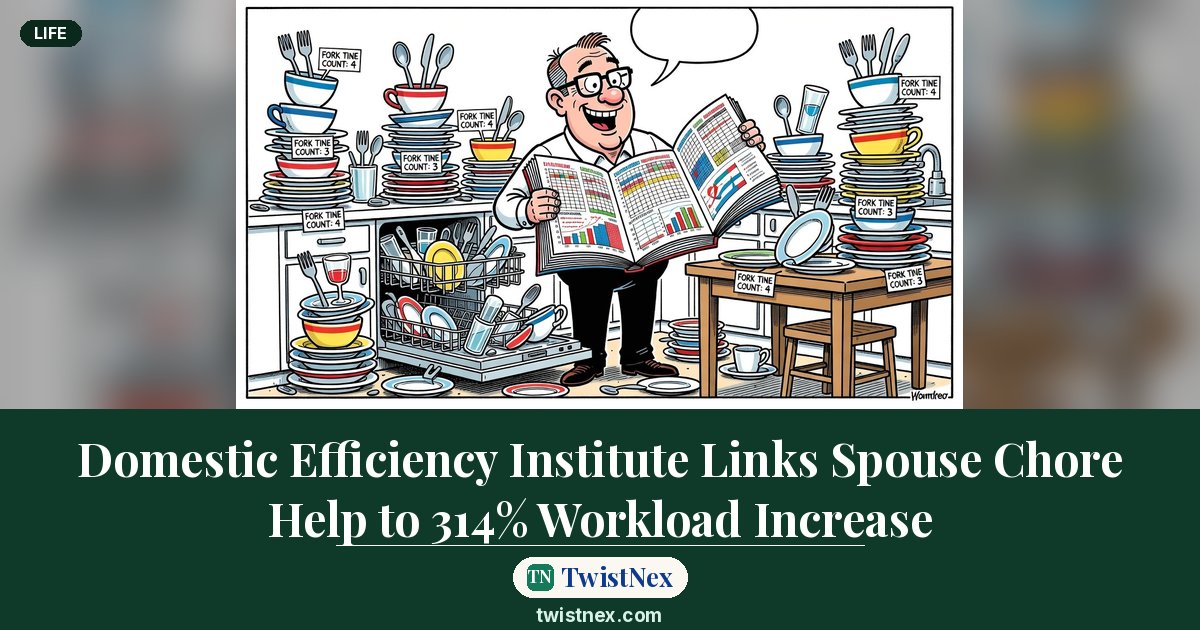
A longitudinal study released Tuesday by the Domestic Efficiency Institute reveals that partners who volunteer for household tasks generate an average 314 percent increase in overall labor hours. Researchers tracked 1,200 couples over eighteen months and determined that self-appointed chore assistants introduce elaborate new protocols that must later be undone by the primary household manager.
In one documented case, a husband assigned to load the dishwasher first removed every item from every cabinet to create an optimal stacking diagram. The resulting schematic required seventeen color-coded spreadsheets and delayed actual dishwashing by nine hours. By the time the original task was completed, three additional meals had been prepared and the sink contained twice the original number of dishes.
Lead researcher Dr. Elena Voss stated that these interventions follow a consistent pattern. "The assisting spouse typically begins with a brief reconnaissance phase that quickly escalates into a complete system redesign," she said. "What appears to be help is in fact the imposition of an entirely new and more time-consuming workflow."
A separate trial examined laundry assistance. Participants who offered to fold clothes first invented a proprietary origami-based folding method requiring each garment to be creased along seven precise axes. Family members later spent an average of forty-three minutes per item attempting to restore shirts to wearable form. The study recorded a 67 percent rise in ironing-related injuries during the same period.
Dr. Marcus Hale, co-author of the report, noted that verbal announcements of intent exacerbate the effect. "When a spouse declares they will 'take care of it,' the remaining partner should immediately block off the following weekend for corrective work," he said. "Our data shows the announcement itself functions as a reliable predictor of subsequent inefficiency."
The institute recommends that households adopt a strict no-volunteer policy for routine chores, limiting assistance offers to written requests submitted at least seventy-two hours in advance. Follow-up surveys indicated that couples who implemented the policy reduced total chore time by 41 percent within the first month.