Study: Couples Require 47 Diplomatic Maneuvers Before In-Law Arrival
Satire: TwistNex is a satirical publication. This is fiction inspired by real news. Quotes, experts and statistics are invented and must not be cited as fact.
New study shows couples now need treaties, earpieces and timed seating charts just to survive a weekend with the in-laws.
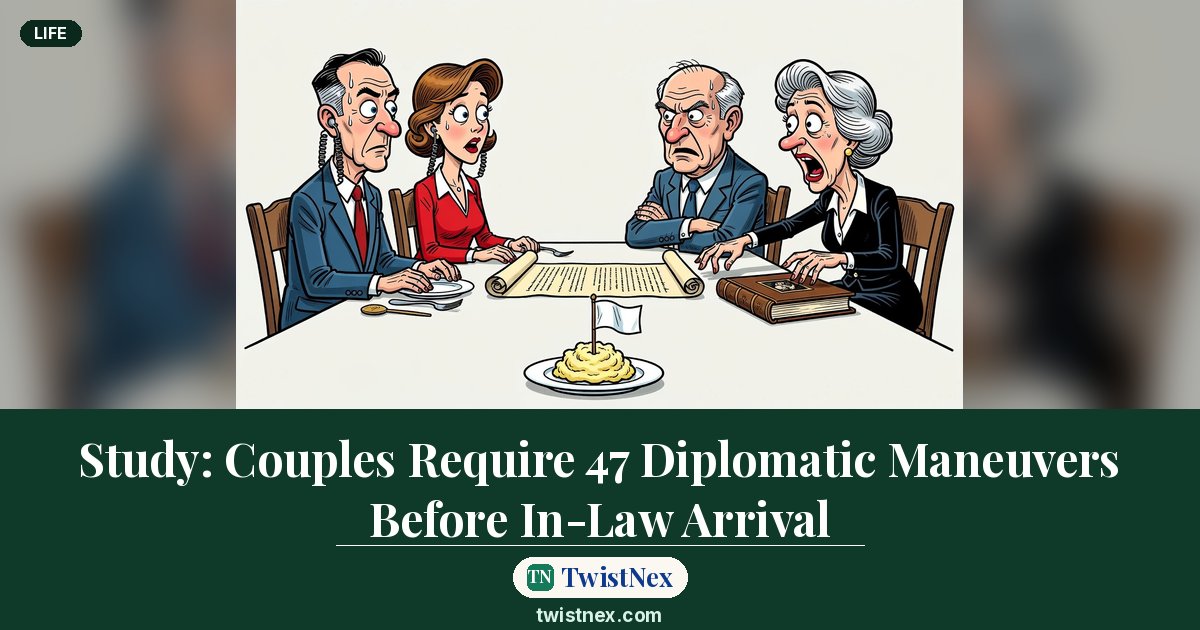
A comprehensive new study released Tuesday by the Center for Familial Conflict Resolution reveals that successful in-law visits now require couples to engage in no fewer than 47 distinct diplomatic maneuvers before the first relative arrives.
Dr. Harold Finch, lead researcher at the center, explained that modern hosting protocols have evolved far beyond simple cleaning. "We've documented cases where spouses spend up to six hours pre-negotiating which topics may be raised at dinner," Finch said. "Mentioning the wrong childhood anecdote can trigger a cascade of relational sanctions lasting months."
The study, which surveyed 2,400 households, found that 92 percent of couples maintain a shared digital document listing approved and prohibited subjects. Common banned items include any reference to past family vacations, career choices, and the couple's decision not to have children yet. In one extreme case detailed in the report, a husband in suburban Ohio was required to wear a discreet earpiece during his mother-in-law's three-day stay. His wife, positioned in an adjacent room, would feed him scripted responses to questions about his lawn care routine.
"Failure to adhere to the protocol resulted in what participants described as 'the long car ride home,' a universally recognized form of post-visit recrimination," the study noted. Additional findings indicate that seating arrangements must be redrawn hourly to prevent any two parties from forming an accidental alliance against a third. Researchers recommend placing at least one neutral object, such as a large floral arrangement or a sleeping pet, between potential adversaries at all times.
"Think of it as shuttle diplomacy, but with mashed potatoes," said Finch. The report further advises against the use of open-ended questions, which experts say create dangerous opportunities for unsolicited advice. Instead, hosts are instructed to prepare a series of closed queries limited to topics such as recent weather patterns and the condition of local roads.
Additional recommendations include the strategic placement of clocks in every room to facilitate timed rotation of conversations and the designation of a neutral "timeout" location, typically the guest bathroom, where either party may retreat without explanation. The institute plans to release a companion app later this year that will allow couples to track compliance in real time using discreet smartphone signals.