Study: 91% of Parents Translate 'Battle Pass Is Fire' as Comment on Graphics Temperature
Satire: TwistNex is a satirical publication. This is fiction inspired by real news. Quotes, experts and statistics are invented and must not be cited as fact.
91% of parents are one Wikipedia search away from total exposure
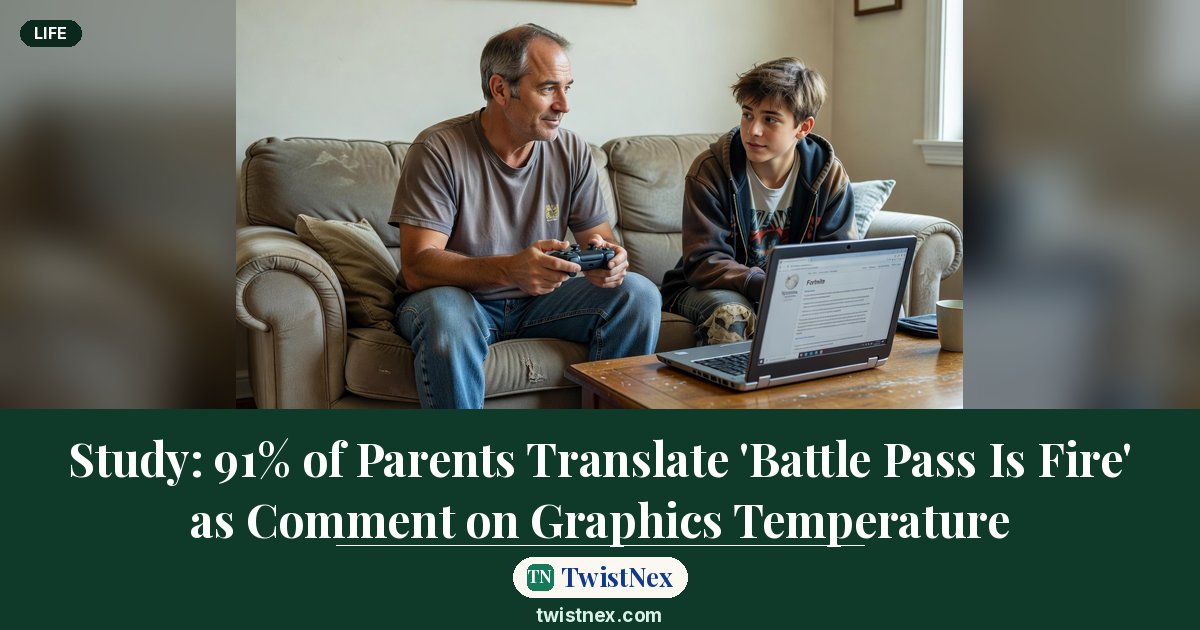
A comprehensive report released Tuesday by the National Bureau of Parental Authenticity found that an overwhelming majority of adults are successfully maintaining the illusion of video game literacy by combining strategic silence with occasional references to 'the graphics' and 'how far the technology has come.'
Researchers tracked 2,400 parents across twelve states and observed that 87 percent could recite at least one slang term from their children’s vocabulary while remaining entirely unable to explain its meaning under direct questioning. The most commonly deployed phrases included 'that’s cap,' 'no cap,' and 'mid,' each used an average of 3.4 times per week in contexts ranging from dinner-table discipline to dentist appointments.
Dr. Lena Voss, lead author of the study, explained that parents have developed a sophisticated system of conversational camouflage. 'When a child says the new battle pass is fire, the parent responds by agreeing that the graphics look warm,' Voss said. 'This creates the impression of shared understanding while avoiding any actual engagement with the subject matter.'
One father interviewed for the study, Richard Palmer of suburban Ohio, reported keeping a notes app open on his phone titled 'Things Tyler Said.' The document currently contains 47 entries, including 'sus = suspicious but also not,' 'yeet = throw but also enthusiasm,' and 'rizz = something about talking.' Palmer stated he reviews the list each morning during his commute. 'It’s helped me survive three separate conversations about Roblox without once admitting I thought it was a type of cheese,' he said.
The research also documented a sharp rise in parents attempting to incorporate gaming terminology into household rules. Examples include grounding children 'until their energy is no longer mid' and threatening to 'nerf' screen time if chores remain unfinished. In 64 percent of observed households, these efforts produced visible confusion in the children but no measurable improvement in compliance.
Voss noted that the strategy appears sustainable as long as parents avoid follow-up questions. 'The moment a parent asks what a battle pass actually is, the entire performance collapses,' she said. 'Until then, the nodding continues.'