NASA Launches $3.5 Billion Telescope to Map Dark Energy It Cannot Explain to Congress
Satire: TwistNex is a satirical publication. This is fiction inspired by real news. Quotes, experts and statistics are invented and must not be cited as fact.
NASA just spent billions to photograph forces no one understands, because the visible universe apparently wasn't mysterious enough.
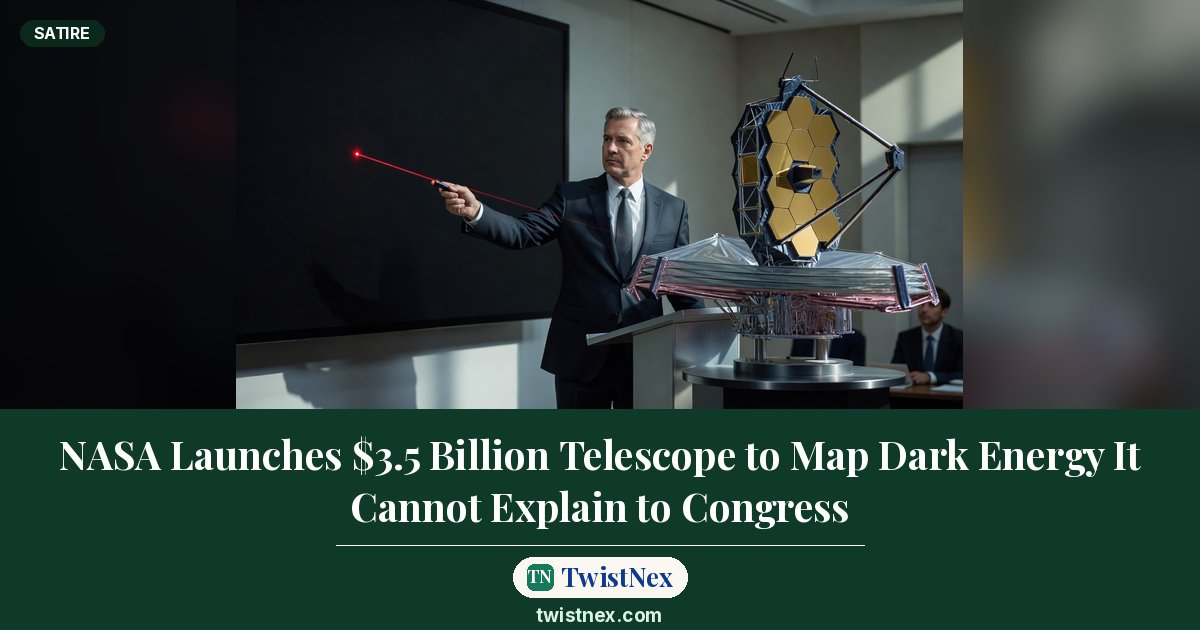
NASA has launched the Nancy Grace Roman Space Telescope on a multi-year mission to create the most detailed map yet of the universe's expansion, dark matter, and dark energy. Officials described the $3.5 billion instrument as a "giant leap forward" in understanding forces that make up roughly 95 percent of everything while remaining completely invisible.
The telescope will spend years staring into blank patches of sky, hoping to detect subtle distortions that might finally explain why the universe is accelerating. Early projections suggest it could return its first usable data sometime after the next three congressional budget cycles and one government shutdown.
A senior NASA administrator, speaking from mission control while standing in front of a PowerPoint slide that was mostly black, said the project represented humanity's commitment to answering the big questions. When asked which specific questions, he clarified that the team would know once the data arrived and someone figured out how to read it.
Critics noted that the same agency has spent decades promising similar breakthroughs with previous telescopes, each one heralded as revolutionary until the next one launched. The Roman telescope's advantage, they added, is that its targets are so fundamentally unknowable that no one can accuse it of underperforming.
Public reaction online has been measured, with many users wondering whether the instrument might accidentally photograph whatever force keeps NASA funding stable while terrestrial science programs face cuts. Astronomers insist the telescope operates independently of earthly politics, which is technically true because it is currently several hundred thousand miles away and therefore unreachable by phone.
The mission's ultimate goal remains ambitious: to produce the first high-resolution atlas of a cosmos that is mostly empty, mostly accelerating, and mostly uninterested in being mapped. NASA says the results will reshape our understanding of reality. In the meantime, the agency has already begun drafting the press release for the next even larger telescope that will be needed to interpret these findings.