Nepal Suspends Flood Rescues to Prevent Helicopters From Becoming Debris
Satire: TwistNex is a satirical publication. This is fiction inspired by real news. Quotes, experts and statistics are invented and must not be cited as fact.
Nepal stops looking for flood victims until the floods agree to cooperate with the search.
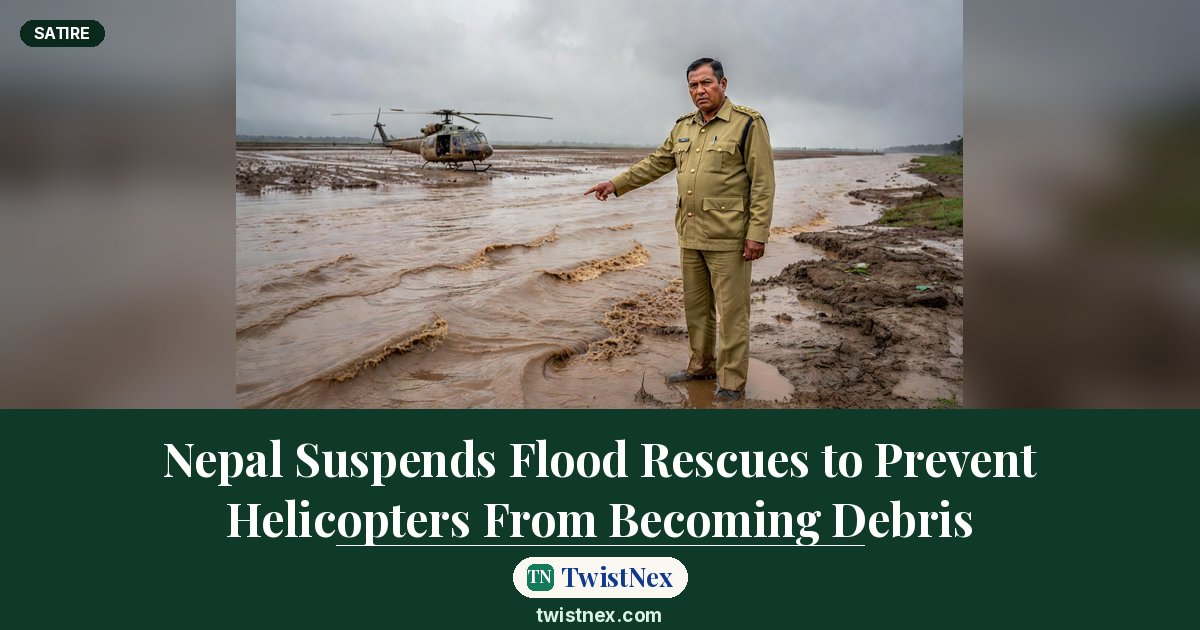
Nepal’s disaster authorities have suspended rescue operations in several districts after determining that ongoing floods posed a risk to the rescue teams themselves. Officials described the decision as a necessary precaution to avoid turning responders into additional casualties in a region already reporting over 750 deaths.
A government spokesperson explained that sending helicopters into active flood zones could result in the aircraft becoming part of the debris field. “We are committed to saving lives, but not at the cost of operational equipment,” the official stated, adding that new protocols now require floodwaters to subside before further searches resume.
Rescue coordinators cited an internal risk matrix showing that any attempt to reach stranded villagers would register as “high hazard” until the hazard itself diminished. One planner noted the approach prevents double-counting victims and simplifies paperwork for international aid agencies.
Local observers pointed out that the policy aligns with long-standing bureaucratic practice of waiting for disasters to become less disastrous before addressing them. “The data clearly shows that floods are wet,” said a consultant brought in to review procedures. “Acting during wetness violates several safety guidelines we wrote after the last flood.”
Tibet’s side of the border issued similar guidance, halting ground teams until meteorologists could confirm the mountains had stopped releasing water. Both governments agreed the strategy reduces liability while the region processes its current missing-persons count, now estimated above three thousand.
Analysts expect operations to restart once conditions improve to the point where rescue is no longer required. In the meantime, the alert system continues to issue warnings about the same weather patterns that prompted the original evacuations.