Navy Designates Mental Health Priority After Crew Calculates Swim Distance to Hawaii
Satire: TwistNex is a satirical publication. This is fiction inspired by real news. Quotes, experts and statistics are invented and must not be cited as fact.
Navy declares mental health a priority right after sailors start treating the ocean like the emergency exit.
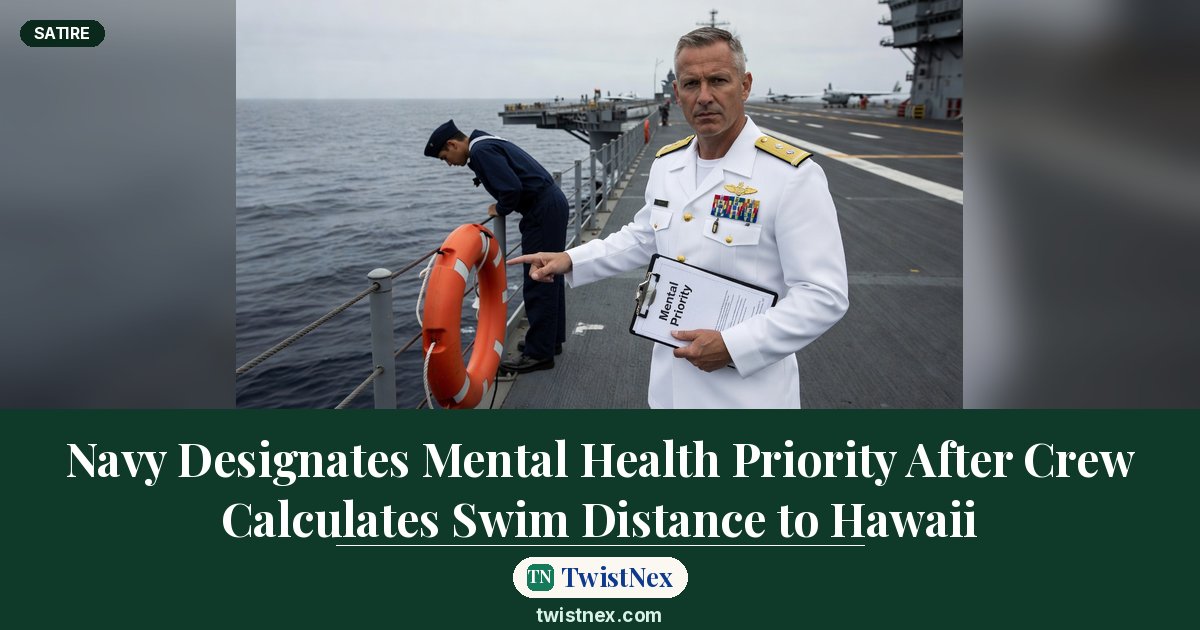
The US Navy announced this week that mental health is now a formal priority aboard the USS Lincoln, a development that arrived shortly after several sailors demonstrated their own coping strategies by trying to exit the vessel via the nearest wave.
Admiral Brad Cooper, fresh from his visit to the carrier, described extended deployments as “uniquely challenging and tough,” which is military-speak for situations where the sea starts looking like the better career move. Lawmakers expressed alarm, noting that the usual package of motivational posters and group sing-alongs may no longer be sufficient when the ocean keeps sending friend requests.
A newly formed wellness committee has reportedly recommended daily “horizon-gazing sessions” and mandatory appreciation circles for the flight deck. One internal memo, circulated with the urgency of a supply request for coffee, suggested that sailors who feel overwhelmed should instead focus on how lucky they are to serve on a floating city that never stops moving away from land.
Independent analysts hired by the Pentagon placed the carrier’s collective stress level somewhere between “mildly concerned” and “actively calculating the swim distance to Hawaii.” The Navy countered that progress is being made because the phrase “mental health” now appears in official emails that previously only discussed ordnance and fuel consumption.
Crew members who remain aboard have been issued new stress balls shaped like tiny life preservers. Those still considering the water have been reminded that the ship’s therapist hotline is answered between 0800 and 0815 on alternate Thursdays, weather permitting.
Defense officials insist the situation is under control. They point to the fact that no one has yet succeeded in completing the transfer, which they classify as a statistically meaningful improvement over previous deployments where the same option was never formally discussed at all.