Pakistan Credits Kashmir Poll Success to Preemptive Shooting of Roadblock Voters
Satire: TwistNex is a satirical publication. This is fiction inspired by real news. Quotes, experts and statistics are invented and must not be cited as fact.
Pakistan just held elections in Kashmir where the safest way to vote was apparently to stay home and watch from a hospital bed.
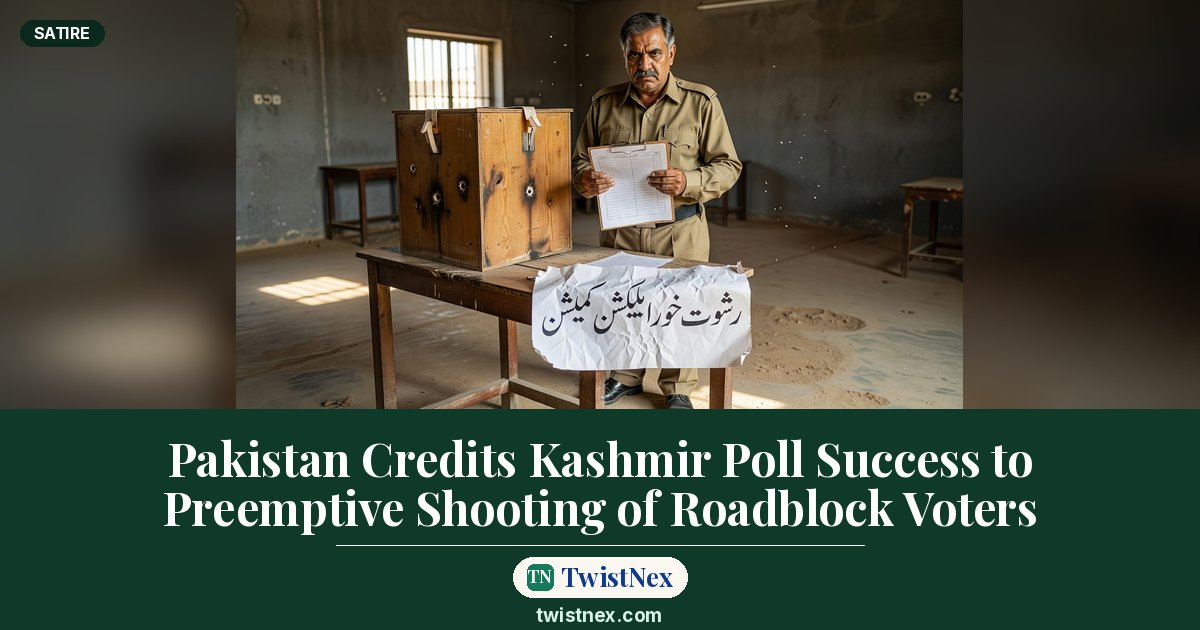
Local elections in Pakistan-administered Kashmir have been declared a resounding success by officials who noted that the only thing smoother than the voting process was the speed at which security forces opened fire on protesters blocking roads. Weeks of demonstrations over broken promises gave way to fatal clashes, proving once again that Islamabad’s crisis-management toolkit contains exactly one tool and it is a rifle.
A senior government spokesperson explained the strategy with admirable clarity: “We encouraged full participation in the democratic process by making non-participation extremely unattractive.” Observers noted that turnout appeared low, but this was largely because many eligible voters were busy dodging live rounds or recovering in hospitals. One unnamed analyst suggested the approach could be exported: “Why bother with voter ID when you can simply provide voter obituaries?”
The road blockades that preceded the voting were described by security officials as “unscheduled traffic-calming measures.” Protesters, for their part, claimed the blockades were about electricity shortages and broken governance, a list of grievances Islamabad immediately addressed by adding fresh bullet holes to the list of local infrastructure problems.
In a post-election briefing, a fictional interior ministry consultant named Dr. Bulletpoint Khan declared the day “a model for conflict resolution in restive regions.” When asked about civilian casualties, he replied that every democracy requires “some give and take, mostly take.” International monitors were reportedly invited to observe but spent most of the day observing the ground from behind concrete barriers.
With the polls now closed and several polling stations literally closed by gunfire, officials have already begun planning the next round of voting. Early indications suggest it will feature even stricter crowd-control measures and possibly fewer candidates who survive the campaign trail.