Analysts Project 34% Support for Democratic Socialism if 'Free Stuff' Appears in Larger Ballot Font
Satire: TwistNex is a satirical publication. This is fiction inspired by real news. Quotes, experts and statistics are invented and must not be cited as fact.
New poll: half of Americans can't explain democratic socialism, but 29% are already in line to vote for it.
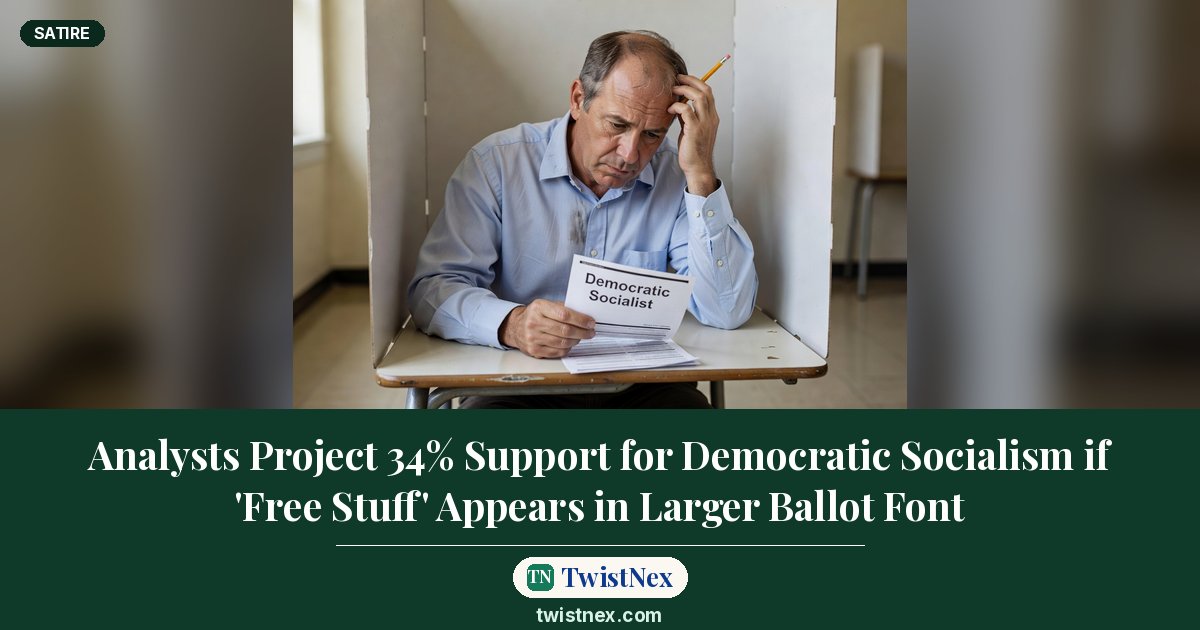
A new Economist/YouGov survey has confirmed what political observers have long suspected: roughly half of Americans cannot accurately describe Democratic Socialist policies, yet 29 percent would still pull the lever for one in a general election. The remaining respondents split between outright rejection and polite confusion, a distribution that political scientists are calling “statistically normal for any ideology ending in -ism.”
Democratic Socialists of America, the group most associated with the label, responded with characteristic optimism. A spokesperson noted that “voters don’t need to understand the platform to benefit from it,” a stance previously floated by luxury car commercials and certain religions. Independent analysts immediately produced a follow-up model projecting that support could rise to 34 percent if the phrase “free stuff” appeared in larger font on future ballots.
The poll’s deeper finding is that familiarity does not breed clarity. Among those who claimed to understand the ideology, answers ranged from “Medicare for all plus trains” to “whatever Sweden does but with more meetings.” When pressed for specifics, one respondent described democratic socialism as “capitalism except the billionaires feel bad about it.”
Campaign strategists on both sides see opportunity. Republican operatives are already testing ads that simply display the poll numbers next to footage of committee hearings. Democratic consultants, meanwhile, are workshopping the phrase “evidence-based vibes” as a rebrand. Neither side appears interested in the 26 percent of respondents who answered “don’t know” to every question, a bloc now being courted by the “Maybe” Party.
Experts warn that rising support without rising comprehension could produce unexpected legislative outcomes, such as universal healthcare paired with a national holiday for misunderstanding taxes. Until then, the 29 percent remain ready to vote for a system they cannot yet define, a level of commitment usually reserved for sports teams and conspiracy theories.