Arizona Moves Primary To July So Candidates Can Debate Gaza While Melting At 110 Degrees
Satire: TwistNex is a satirical publication. This is fiction inspired by real news. Quotes, experts and statistics are invented and must not be cited as fact.
Arizona moved its primary to July so candidates could argue about Gaza while voters debate whether leaving the house is worth heatstroke.
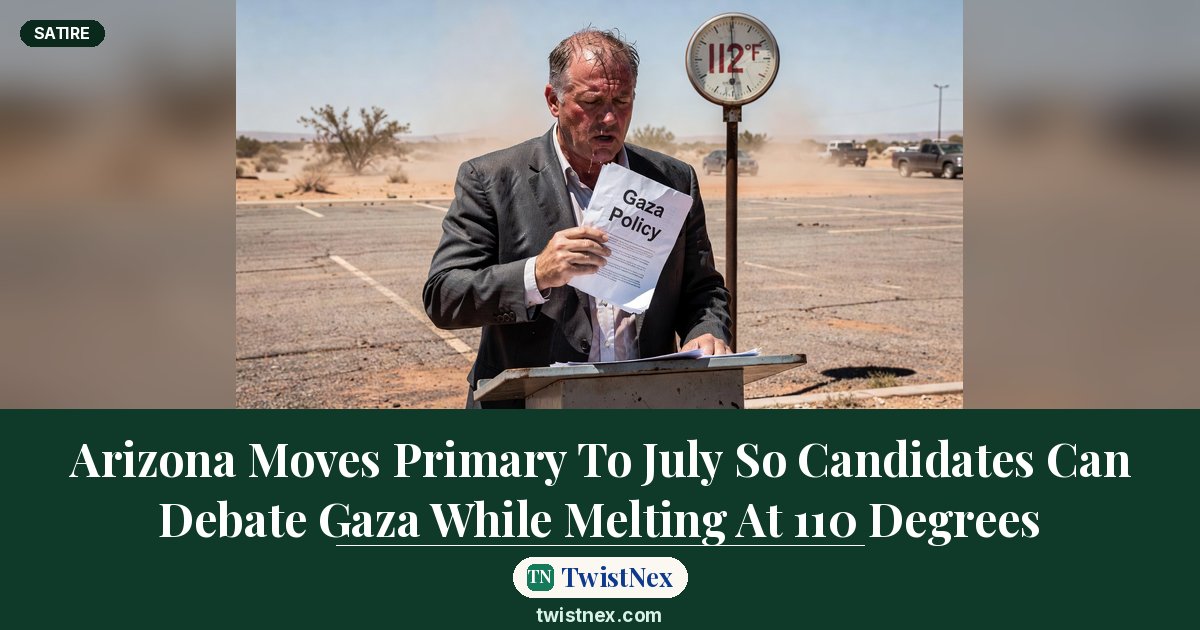
Arizona lawmakers advanced the state’s primary to July, claiming the extra weeks would help election officials prepare for November without the usual August scramble. Voters are now expected to decide major races for governor and Congress while temperatures hover near 110 degrees, a schedule that treats heatstroke as a minor inconvenience rather than a campaign strategy.
Democratic candidates have spent recent weeks sparring over Gaza policy even though the ballot contains no foreign-aid measures and the state budget already struggles to keep rural hospitals open. One contender released a detailed ceasefire plan while another accused her of “importing Middle East drama to the Grand Canyon,” a line that somehow passed for substance in local forums.
Republicans, sensing an opening, have focused on promising to lower utility bills that spike every summer, though their proposals so far consist mainly of blaming the previous administration for sunshine. Polling averages show enthusiasm among likely voters hovering near single digits, a figure analysts attribute to the combined effects of triple-digit heat and the realization that no candidate can actually control international events from the state capitol.
Election officials insist the earlier date prevents the kind of rushed certification that plagued prior cycles, a defense delivered without irony as ballots are printed in a season when ink itself risks evaporating. Early voting sites report turnout that would embarrass a school-board meeting, with most residents opting to remain indoors rather than debate ceasefires in parking lots.
By November the state will have had four additional months to forget these choices entirely, which may be the only measurable success of the schedule change. Candidates continue to insist the contest remains vital, a claim that grows less convincing each time a voter asks whether the debate stage comes with air conditioning.