80% of Data Centers Now Drafting Evacuation Plans For Disasters Their Servers Intensified
Satire: TwistNex is a satirical publication. This is fiction inspired by real news. Quotes, experts and statistics are invented and must not be cited as fact.
AI data centers are discovering climate change the hard way: by getting flooded by the weather they’re helping create.
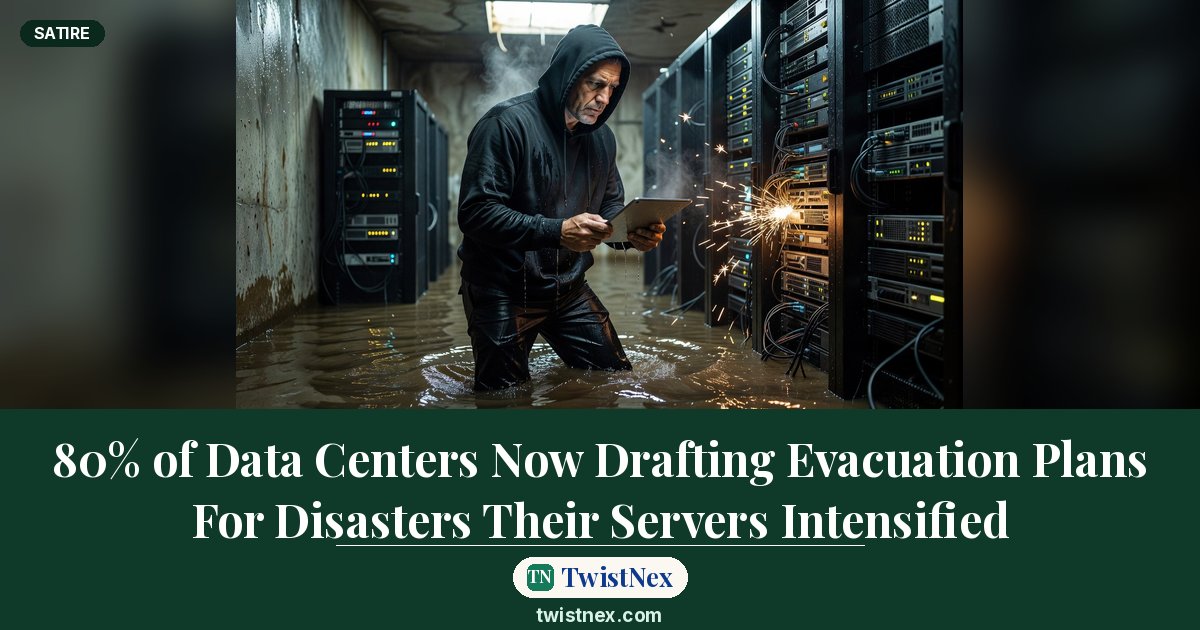
A new study confirms that nearly 80 percent of the world’s data centers sit squarely in the path of floods, wildfires and heat waves their own electricity demands are making worse. The same facilities training AI to write poems and deny elections are now drafting their own evacuation plans for extreme weather.
Tech executives insist the problem is temporary. One industry source, speaking on condition of absolute secrecy, claimed the solution is “training larger models to generate better weather.” Another suggested simply moving the servers to higher ground and calling it “innovation.” Both proposals were accompanied by the sound of servers already short-circuiting in real time.
Meanwhile, polling shows most American voters have connected the dots between record heat and climate change, leaving politicians who still call it a hoax looking like the only ones left using dial-up. The gap has become so obvious that some campaigns now treat public understanding of basic physics as evidence of radicalization.
The deeper irony is that the AI boom’s power appetite is accelerating the very hazards now threatening its infrastructure. Insurance costs are rising, downtime is lengthening, and repair crews are being asked to work during hurricanes because the quarterly targets cannot be delayed. One analyst projected that by 2028 the average data center will spend more on climate-related repairs than on the GPUs themselves.
In response, several companies have announced new “resilient AI” initiatives. These involve building smaller, more distributed facilities that can fail one at a time rather than all at once, a strategy previously known as “pretending the problem is distributed.”
The public, apparently ahead of both politicians and server-farm operators, continues to notice when the weather feels different. The machines, for their part, are simply waiting for the next prompt that explains why the lights keep going out.