EU Estimates Ukraine Entry After Three More Wars And One Tractor Regulation Update
Satire: TwistNex is a satirical publication. This is fiction inspired by real news. Quotes, experts and statistics are invented and must not be cited as fact.
EU starts Ukraine accession talks and immediately sets expectations at 'maybe by mid-century.'
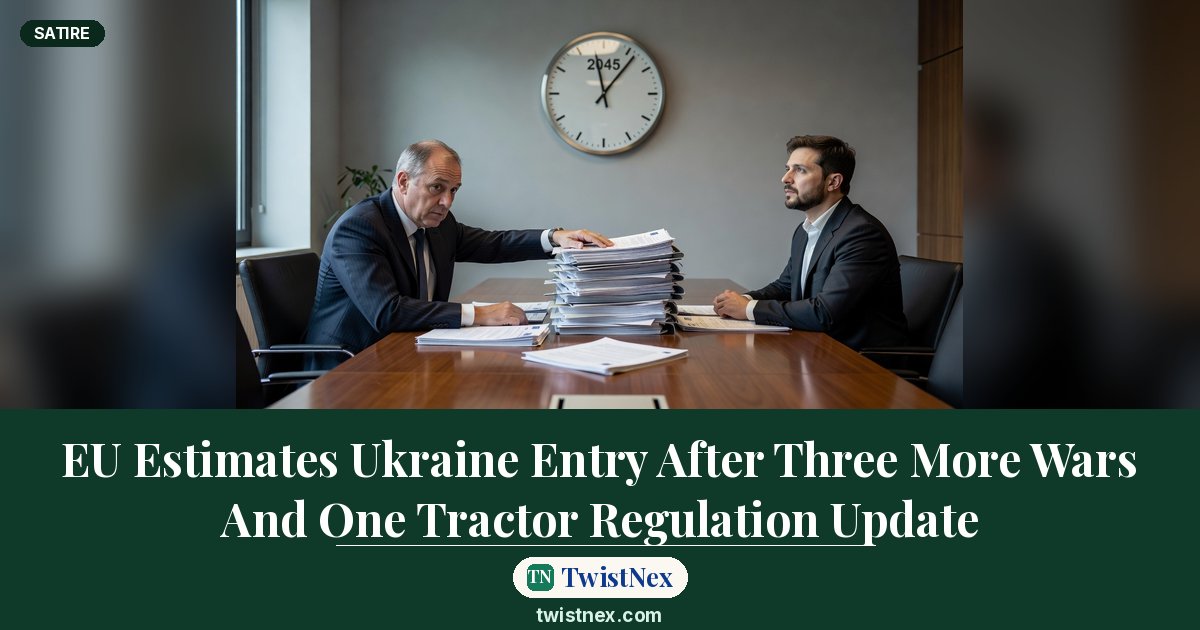
The European Union has formally opened accession talks with Ukraine and Moldova, a move officials described as historic while privately calculating it will require at least two decades of committee meetings, veto threats, and agricultural subsidy arguments. The decision came after Hungary’s new government lifted its blockade, reportedly in exchange for unspecified future concessions that will themselves require another set of negotiations.
Brussels presented the step as a powerful security guarantee for a country currently fighting an invasion. In practice, the process begins with screening laws, chapters, and benchmarks that have historically taken candidate countries between seven and fourteen years before any actual membership card is printed. Ukrainian officials welcomed the news as validation of Western alignment, then returned to requesting weapons that the same Western allies have spent months debating.
EU diplomats stressed that the timeline is flexible and could accelerate if all member states maintain consistent political will. Observers noted that consistent political will among twenty-seven capitals has not been observed since the introduction of the euro. One unnamed Commission source estimated Ukraine might complete the process “shortly after the last remaining Soviet-era tractor regulation is harmonized and Russia has been convinced to sign off on the border chapter.”
Moldova, already accustomed to being mentioned in the same sentence as larger neighbors, received identical language and identical optimism. Analysts predict both countries will spend the coming years producing reform reports that Brussels will file next to earlier reports from Turkey, North Macedonia, and Albania.
The most immediate effect has been a surge in consultancy firms offering to explain the acquis communautaire to exhausted government ministries. No one has yet calculated the cost of translating every EU directive into Ukrainian, but early bids already exceed the GDP of several existing member states.