U.S. Lifts Venezuela Oil Sanctions Now, Defers Free Elections Until Crude Runs Dry
Satire: TwistNex is a satirical publication. This is fiction inspired by real news. Quotes, experts and statistics are invented and must not be cited as fact.
Trump swaps sanctions for barrels while Venezuelans wait for the fine print on elections.
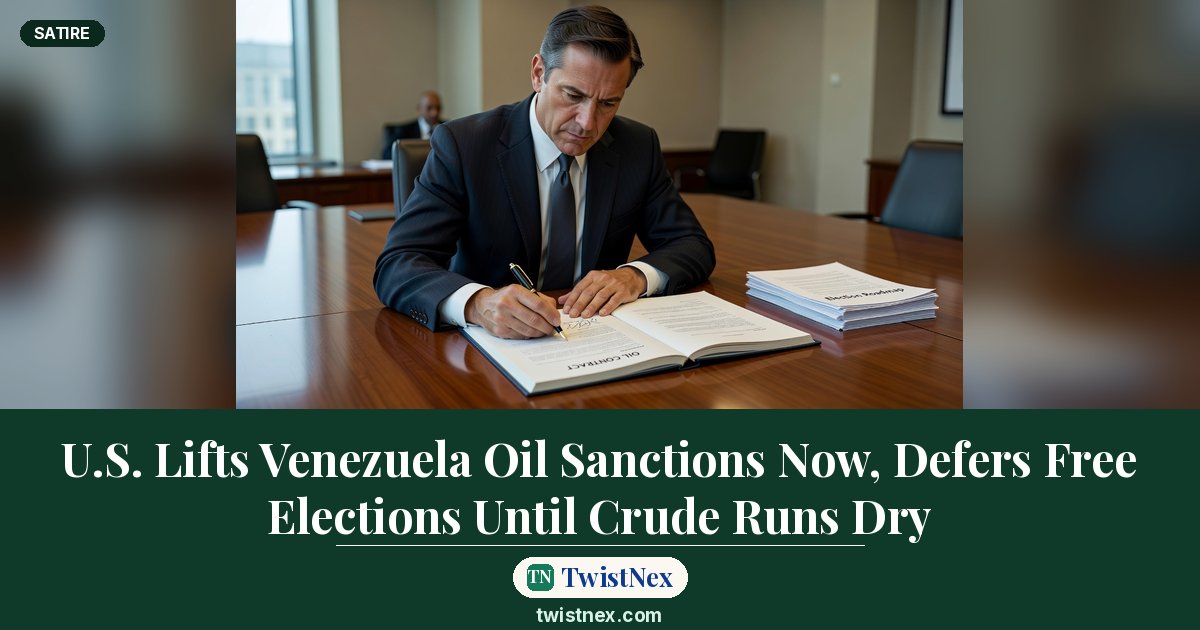
The White House announced a landmark agreement this week that will ease sanctions on Venezuelan oil exports while urging Caracas to hold free elections at some unspecified future date. Administration officials described the pact as a breakthrough that finally puts America’s energy security first.
Under the terms, Chevron and other U.S. firms gain expanded access to heavy crude, production targets are projected to rise sharply, and sanctions relief arrives immediately. Election language appears in an annex described by one official as “aspirational but non-binding.”
Venezuelan citizens hoping the deal might pressure Nicolás Maduro toward credible voting now face a clearer timeline: oil tankers first, ballot security later. One Caracas analyst noted the sequence is efficient because crude moves faster than international observers.
Industry analysts greeted the news with spreadsheets showing projected revenue curves that peak well before any hypothetical 2026 vote. A senior energy consultant, speaking on condition of anonymity, said the administration had finally recognized that democracy is a long-term process while gasoline prices are not.
Maduro’s government welcomed the pragmatic tone, issuing a statement praising the deal’s respect for national sovereignty and its silence on term limits. Opposition figures responded with statements that were notably shorter than the contract addendums granting drilling rights.
White House spokespeople insist the agreement contains strong human-rights language that can be activated once quarterly oil volumes are met. Until then, the focus remains on barrels per day rather than voters per precinct.
The deal is already being studied by other nations as a model for exchanging political ambiguity for immediate energy dividends. Observers predict similar frameworks will soon be drafted for any regime willing to sign the bottom line first and the democratic checklist second.