White House Says Argentine Beef Will Teach U.S. Cows To Complain Less
Satire: TwistNex is a satirical publication. This is fiction inspired by real news. Quotes, experts and statistics are invented and must not be cited as fact.
Trump fixes American beef prices the old-fashioned way: by bringing in cheaper steak from Argentina while US ranchers stand there smiling.
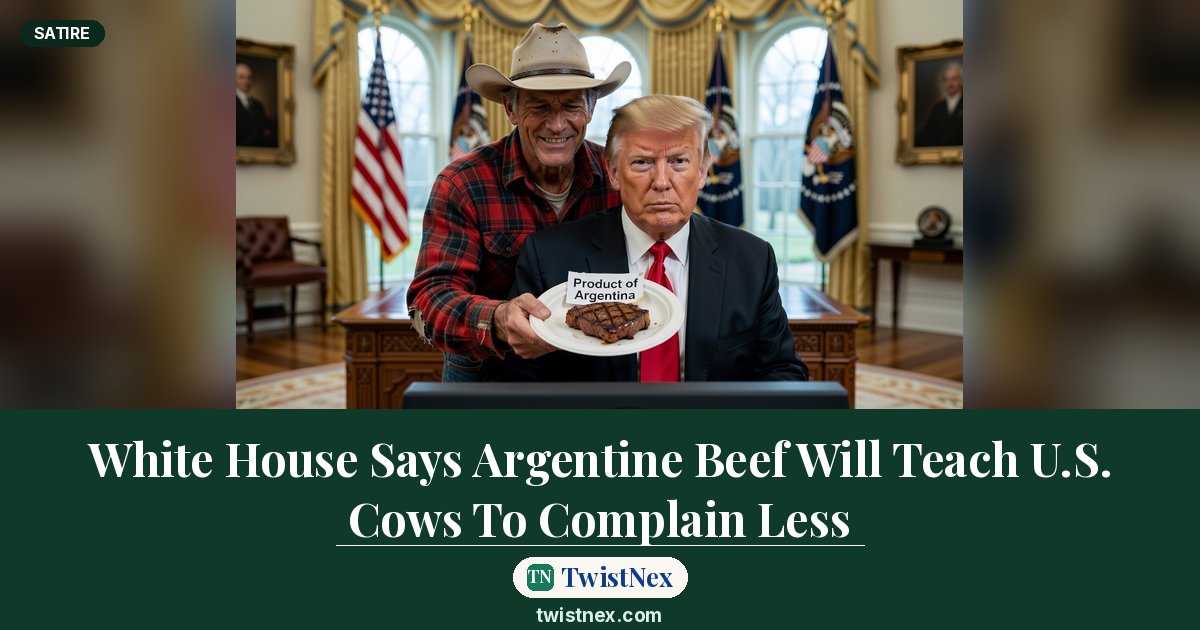
President Trump announced Friday that tariff-free beef from Brazil and Argentina will soon flood American supermarkets, a move designed to bring down stubbornly high prices that have left ranchers and consumers equally frustrated.
Surrounded by a group of US cattle producers at an Oval Office event, Trump explained the plan with characteristic clarity. “It’s coming from Argentina. It’s coming from Brazil,” he said, adding that other unnamed countries were also contributing. The ranchers behind him nodded politely, their expressions suggesting the sudden arrival of foreign competition was exactly the relief they had been waiting for.
Administration officials described the imports as a bold market correction. One senior adviser, speaking on condition of anonymity, claimed the policy would “teach American cows to work harder and complain less.” A hastily produced White House fact sheet listed projected benefits including lower grocery bills, improved diplomatic relations with South American cattle exporters, and an unspecified uptick in national “beef optimism.”
Critics noted the irony of an administration that spent years promising to protect domestic agriculture now turning to foreign suppliers. Trump dismissed the concern, insisting the imported beef would carry special labeling so patriotic consumers could still choose American product if they enjoyed paying more. A Department of Agriculture spokesperson added that the new beef would undergo rigorous inspection, though the department declined to specify what “rigorous” meant beyond “someone will look at it briefly.”
The announcement comes as meat prices remain elevated despite earlier tariff policies aimed at shielding US producers. Economists warned that the sudden influx could pressure smaller ranches, but the White House countered that smaller ranches simply needed to become more competitive or consider alternative careers in tourism or artisanal candle-making.
As the event concluded, one rancher was overheard asking quietly whether the imported steaks would at least come with a side of subsidies. Officials did not respond.