DHS Requires Three Forms and Lost Ark Before Confirming Refugee Froze Outside
Satire: TwistNex is a satirical publication. This is fiction inspired by real news. Quotes, experts and statistics are invented and must not be cited as fact.
DHS has turned a basic records request into performance art while lawmakers try to learn why a blind refugee was left outside in the Buffalo cold.
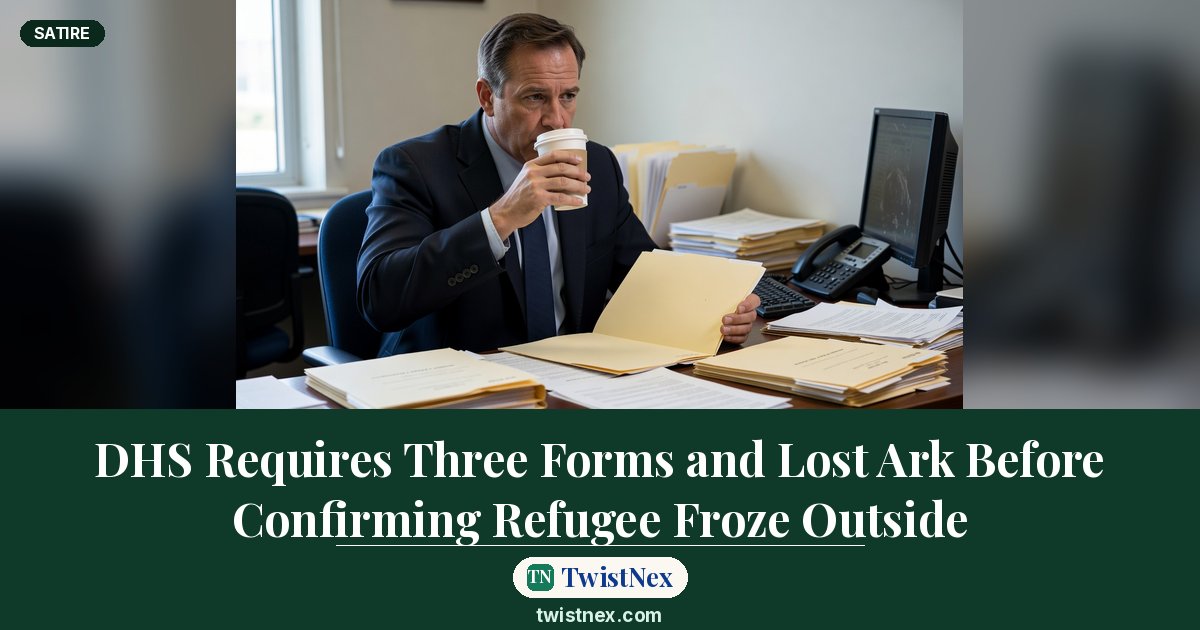
Democratic lawmakers are still waiting for the Department of Homeland Security to hand over anything resembling records on how a nearly blind Rohingya refugee ended up dying after agents deposited him outside a locked coffee shop in Buffalo. The agency has responded with the bureaucratic equivalent of a shrug so powerful it registered on the Richter scale.
Internal sources describe a department so committed to “process” that locating basic incident reports now requires three forms, two signatures, and apparently the lost Ark of the Covenant. One senior official reportedly suggested the matter could be resolved faster if everyone simply agreed the coffee shop was closed, as though that settled the temperature outside.
Lawmakers have escalated from polite letters to public demands, which in Washington counts as a full-blown meltdown. DHS, meanwhile, continues to operate under the working theory that accountability is a seasonal item available only during non-election years. Staffers familiar with the case say any release of documents would require “careful review” that could take until the next ice age, conveniently timed after the next round of budget hearings.
The episode has produced the rare bipartisan spectacle of elected officials asking an agency to explain why it appears to treat human beings like returned Amazon packages left on the wrong porch. So far the only thing delivered with speed and accuracy is the department’s standard reply: “We are reviewing the request.”
Critics argue this level of stonewalling sets an impressive new standard for turning a straightforward inquiry into performance art. DHS leadership has yet to comment, citing the need to first locate the comment in its own filing system.