New Jersey Asks Supreme Court to Ban Betting Markets Offering No 30% Cut
Satire: TwistNex is a satirical publication. This is fiction inspired by real news. Quotes, experts and statistics are invented and must not be cited as fact.
New Jersey wants the Supreme Court to ban prediction markets because the state can’t skim its usual cut—pure regulatory principle at work.
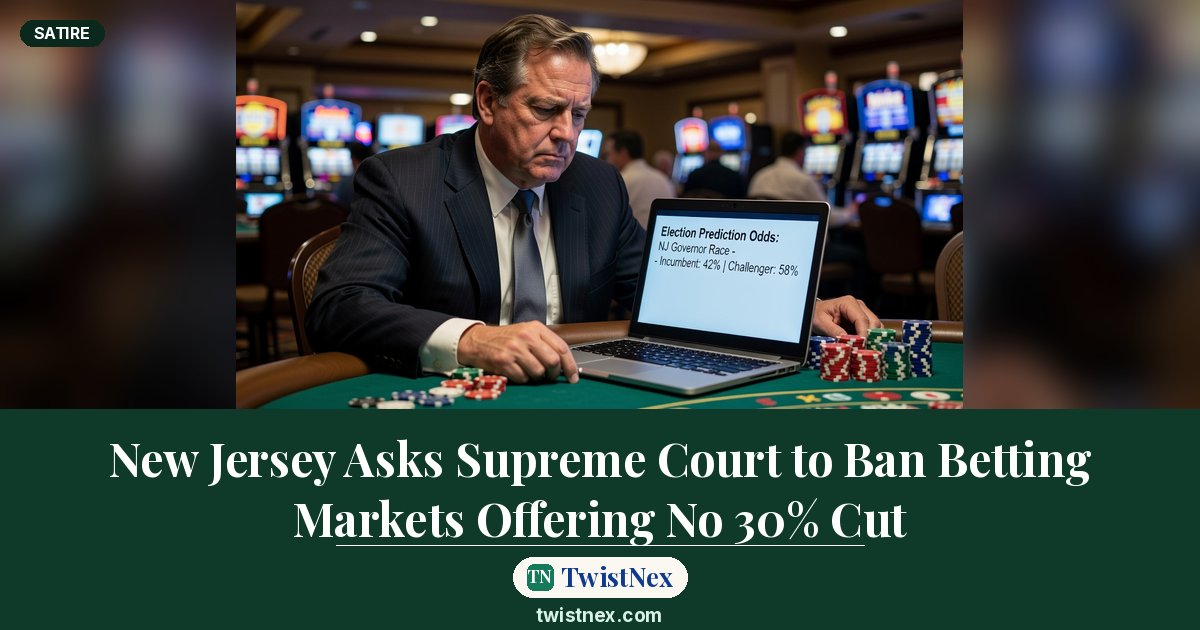
New Jersey has asked the Supreme Court to step in and block prediction markets, claiming the 9th Circuit got it wrong on sports-event contracts. The state that built an entire economy around people losing money on football now insists that letting citizens wager on elections and corporate earnings is simply too dangerous.
Officials argue that unregulated platforms give bettors an unfair edge by skipping the licensing fees, advertising restrictions, and state cut that Atlantic City casinos must pay. “If we can’t take thirty percent off the top, it’s not gambling anymore—it’s anarchy,” said one Trenton regulator who asked not to be named because his own bracket pool is still active.
The petition arrives just as prediction markets have begun pricing in the likelihood of various policy outcomes with uncomfortable accuracy. Lawmakers worry citizens might start treating public decisions like a futures contract rather than waiting for the next legislative session to be surprised. Early internal models reportedly showed bettors correctly forecasting both the next interest-rate move and the exact moment a certain senator would change his mind on the bill.
Critics note the irony of New Jersey demanding federal intervention to protect its gambling monopoly while simultaneously advertising “legal sports betting for everyone” on every highway billboard. A source close to the governor described the contradiction as “a feature, not a bug,” before immediately clarifying that the governor had no comment.
If the Court accepts the case, observers expect arguments that prediction markets threaten everything from state revenue to the sacred tradition of being slightly misinformed about politics. Until then, New Jersey will continue welcoming visitors who prefer their bets come with house odds, complimentary drinks, and absolutely no transparency on the math.