Autonomous Firms Call 33-Foot GPS Drift Acceptable Creative Interpretation of Road
Satire: TwistNex is a satirical publication. This is fiction inspired by real news. Quotes, experts and statistics are invented and must not be cited as fact.
GPS satellites just developed a 33-foot attitude problem and your self-driving car is listening.
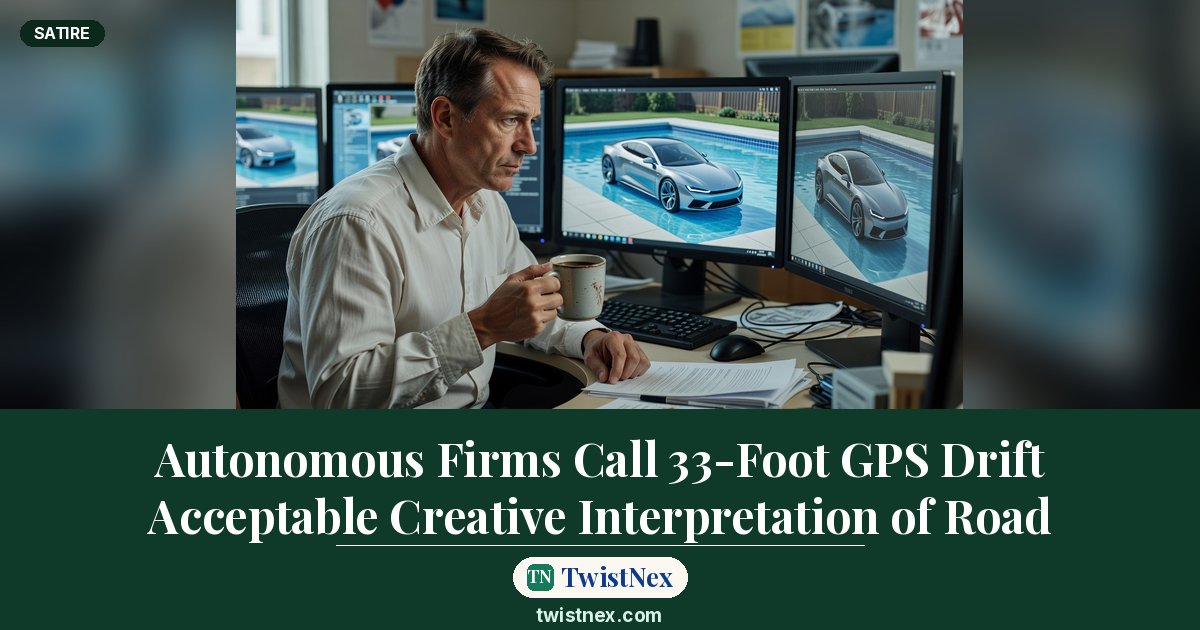
Researchers monitoring global positioning systems have confirmed that satellite signals are suddenly drifting by up to 33 feet, a margin large enough to turn autonomous vehicles into expensive lawn ornaments.
The discrepancy, detected across multiple monitoring stations, has prompted urgent calls for software patches that experts admit may not arrive before the next software update cycle in 2027.
Autonomous vehicle companies have responded by lowering their safety claims rather than fixing the hardware. One internal memo obtained by sources described the 33-foot error as "within acceptable creative interpretation of the road."
Dr. Lena Voss, a fictional satellite behavior specialist at the Institute for Obvious Problems, explained that the drift appears random but consistently favors locations with expensive real estate. "The cars aren't malfunctioning," she said. "They're just developing expensive tastes."
Transportation officials have advised drivers to keep hands on the wheel, a recommendation previously dismissed as unnecessary by the same companies that spent billions convincing regulators otherwise. Commuters are now being told to treat their vehicles like very expensive, very confused horses.
Ride-hailing fleets have begun offering "manual override discounts" while quietly increasing insurance reserves. Several cities have reported an uptick in autonomous vehicles politely attempting to parallel park inside living rooms.
Industry analysts predict the issue will resolve itself once enough vehicles have demonstrated the problem in court. Regulators, for their part, are forming committees to study whether satellites should be required to pass basic driving tests.
Until then, passengers are advised to treat every trip as an unexpected detour with potential for both property damage and viral footage.