Officials: Inmates Must Maintain Caloric Intake to Avoid Opting Out of Justice System
Satire: TwistNex is a satirical publication. This is fiction inspired by real news. Quotes, experts and statistics are invented and must not be cited as fact.
Federal judge rules the accused shooter must be kept alive to face trial, because apparently due process includes mandatory lunch.
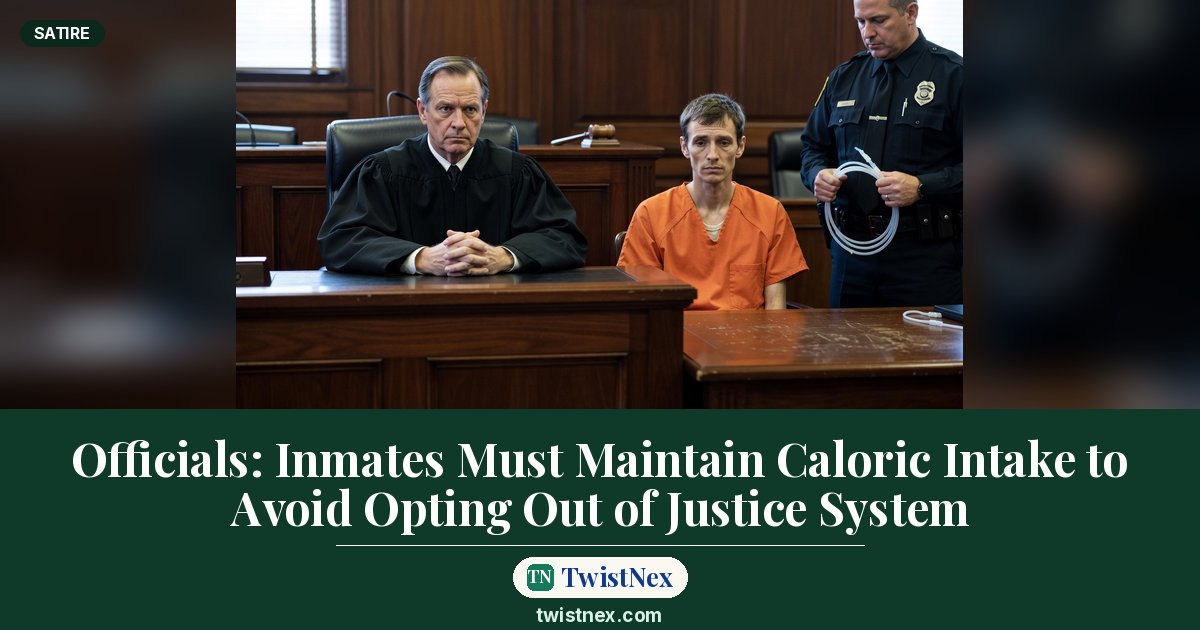
U.S. District Judge Amit Mehta has decided that the Bureau of Prisons may now administer nonconsensual nutrition to Rahmanullah Lakanwal, the Afghan national accused of ambushing two National Guard members in Washington last year. The brief order treats hunger striking as an unacceptable shortcut around due process, ensuring the defendant remains physically able to attend every scheduled hearing.
Federal officials described the ruling as a routine application of medical standards inside detention facilities. A Bureau of Prisons spokesperson, speaking on condition of anonymity, noted that inmates are expected to maintain baseline caloric intake so the government can complete the paperwork required to prosecute them. “We’re not in the business of letting people opt out of the justice system through poor dietary choices,” the spokesperson said.
Critics outside the courtroom suggested the decision reveals a familiar institutional priority: the system will expend considerable resources keeping a defendant alive long enough to convict him, after which it will expend even more resources keeping him alive in prison. Legal analysts projected that similar orders could soon apply to defendants who attempt to skip arraignments by developing sudden allergies to the entire concept of court.
The ruling arrives at a moment when federal agencies already face questions about the cost and consistency of detainee care. One unnamed court watcher estimated that force-feeding protocols now require roughly the same administrative effort as processing a routine motion to dismiss, only with more tubes. Defense attorneys declined to comment beyond noting that their client continues to prefer his own nutritional plan.
Outside the courthouse, no one appeared surprised that the government had again chosen to treat a hunger strike as an administrative inconvenience rather than a personal decision. The order simply confirms that, in federal custody, refusing food is no longer considered a valid form of protest once prosecutors have filed charges. The Bureau of Prisons is expected to begin implementation immediately, with regular medical monitoring to confirm the defendant meets the caloric thresholds necessary for continued participation in the legal system.