Telescope Logs White House Call as Successful Test of Autonomous Rejection Filter
Satire: TwistNex is a satirical publication. This is fiction inspired by real news. Quotes, experts and statistics are invented and must not be cited as fact.
Trump tried to task a $3.5 billion infrared telescope with locating political anomalies; mission control treated it like a routine RFI complaint.
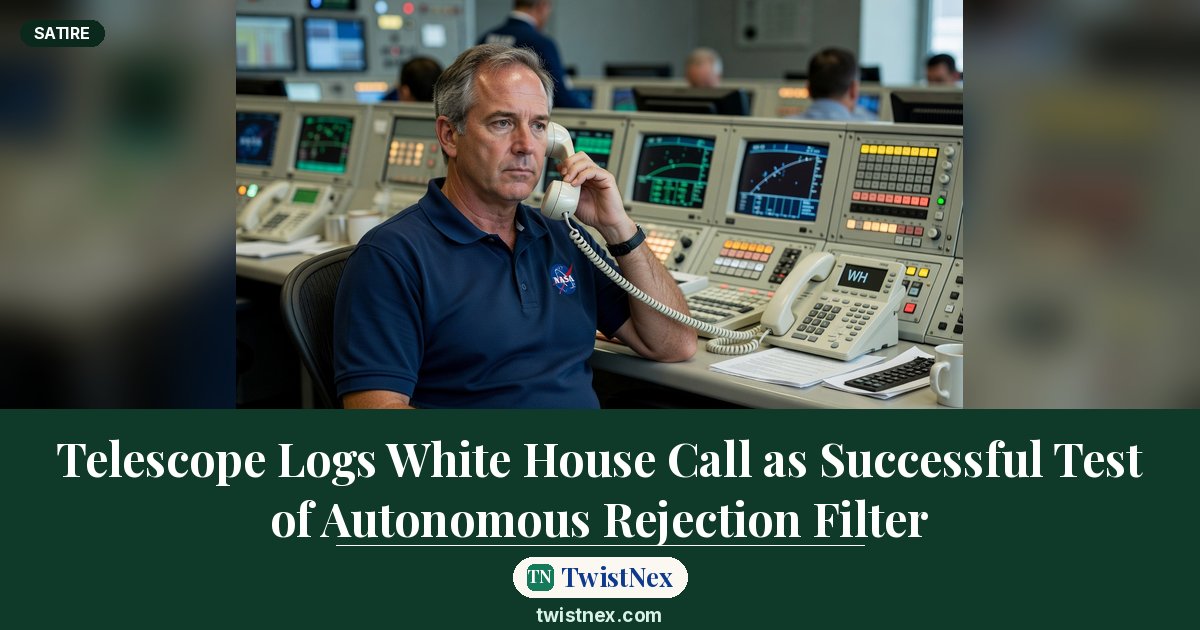
NASA and SpaceX opened the post-launch briefing by confirming the Roman Space Telescope had reached its station and begun calibrating its 2.4-meter mirror for faint infrared signals.
President Trump joined the line three minutes later and asked whether the instrument could isolate unusual gravitational lensing around properties linked to political opponents.
The project scientist, identified on the call as Deputy Director of Anomalous Optics for the Office of Celestial Distractions, replied that the telescope’s survey fields were fixed by orbital mechanics and not by subpoena.
Trump then requested a priority observation slot for any exoplanets whose atmospheres registered elevated levels of “fake news particles,” citing the telescope’s stated goal of finding the weird, the rare, and the unusual.
SpaceX representatives noted that downlink schedules were already locked and that additional targets would require a formal change request routed through the agency’s orbital allocation board, a process that typically takes eleven months.
The same official added that the telescope’s data pipeline contained no provisions for attaching executive branch talking points to raw pixel files.
After twenty minutes the connection dropped when the White House operator attempted to transfer the call to the telescope’s onboard computer, which lacks a handset.
Mission control logged the interruption as a successful test of the spacecraft’s autonomous rejection filter for non-celestial noise.