DHS Creates Committee on Acceptable Foreign Opinions in Room With One Working Bulb
Satire: TwistNex is a satirical publication. This is fiction inspired by real news. Quotes, experts and statistics are invented and must not be cited as fact.
Trump admin learns the hard way that the First Amendment still applies to people who can’t vote them out of office.
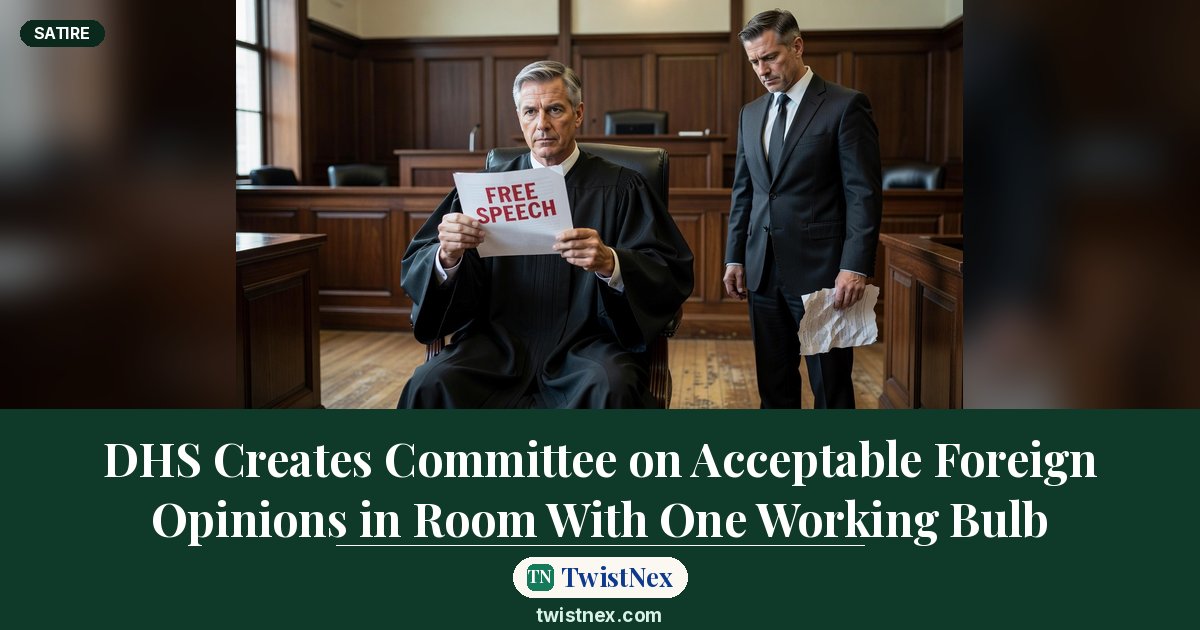
A federal judge has blocked the administration’s latest effort to remove foreign students who attended protests, citing an obscure clause about speech that still applies to people without voting rights.
The ruling came after officials presented evidence including a student’s social media post and a campus flyer with the wrong font size. The Department of Homeland Security responded by creating a new interagency panel called the Committee on Acceptable Foreign Opinions, which meets in a windowless room with one working light bulb.
“Deportation remains an available tool for any non-citizen whose views create scheduling conflicts for enforcement officers,” said the panel’s chair, whose official title is Deputy Undersecretary for Narrative Alignment.
The government argued that allowing the students to remain would force agents to waste time distinguishing between protected speech and speech that simply annoys the current administration. The judge replied that the Constitution does not include an annoyance exemption.
Internal memos obtained by the court described a proposed three-step process: first issue a notice to appear, then schedule a hearing, then realize the hearing would require acknowledging the First Amendment. The final step was never completed.
One student facing removal had posted a photo of a protest banner. Officials classified the banner as a security threat because it used the color red, which appears on several watch lists for reasons no one could fully explain during the hearing.
The administration now plans to appeal by arguing that free speech protections should be treated as a limited-time offer that expires when the speaker is not a citizen. The judge set the next hearing for a date after the next election cycle, citing the need for both sides to prepare additional paperwork that will likely be ignored.