Birmingham Council Warns Flags Must Not Create Impression of Widespread National Sentiment
Satire: TwistNex is a satirical publication. This is fiction inspired by real news. Quotes, experts and statistics are invented and must not be cited as fact.
Birmingham now requires planning permission to hang a flag that matches the country it’s in.
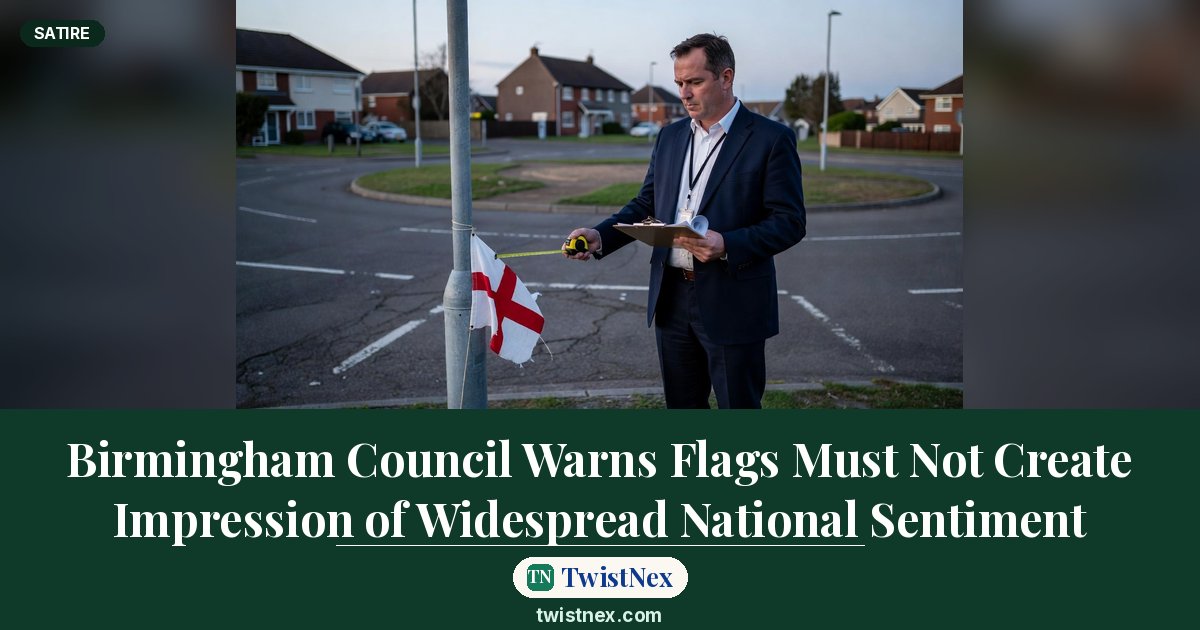
Birmingham city council has asked a judge to order an anti-migrant campaign to stop fixing St George’s crosses and Union Jacks to street poles, roundabouts and bridge railings.
The application cites load calculations, visual-clutter rules and the sudden need for every vertical surface to undergo a “non-symbolic impact assessment” before any national colours are added.
An official in the council’s newly formed Flag Compliance Unit explained the process requires advance notice, structural drawings and a signed declaration that the flag will not “create an impression of widespread national sentiment.”
Residents who complained about the campaign say the real problem is enforcement, not the flags themselves. One local noted that the same lamp posts have carried election posters, lost-pet notices and pizza-delivery stickers for years without a single structural survey.
A council spokesperson described the group’s actions as “unauthorised vertical messaging” and warned that continued flag placement would trigger daily fines plus an additional charge for each repeated attachment. The spokesperson added that the policy applies equally to all flags, “including those commemorating the local under-11s football tournament that used the same poles last season.”
The group behind the campaign has so far refused to remove the flags, stating only that the council appears more concerned with fabric than with the condition of the actual roads. Court documents show the council is also requesting powers to confiscate any flags found above two metres in height without prior written consent.
Legal observers expect the hearing to focus on whether a single square metre of polyester can be classed as a permanent alteration to public infrastructure under existing highway regulations.