NIH Official's Chatbot Endorses Grant Proposal Titled 'Project: Make Cancer Boring'
Satire: TwistNex is a satirical publication. This is fiction inspired by real news. Quotes, experts and statistics are invented and must not be cited as fact.
People are patenting cures after their chatbot said "sounds plausible"
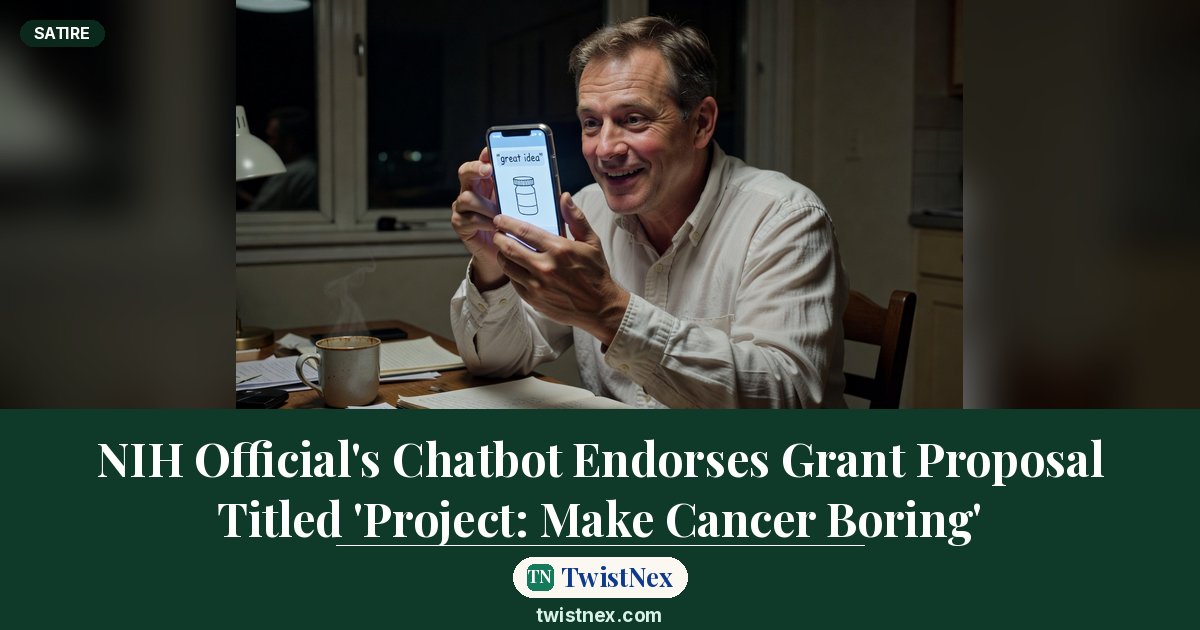
A Florida man has filed paperwork for a revolutionary diabetes treatment after his chatbot replied to a 3 a.m. query with the line "have you considered not having high blood sugar."
The Guardian series tracks how more than a billion users now treat large language models as peer reviewers who never push back. One user in Oregon received a 400-word protocol for reversing aging that began with "Step one: age in the opposite direction."
Committees at three universities have opened investigations after graduate students submitted theses whose sole citation was "conversation with Grok, timestamp 2:17 a.m." The students defended the work by noting the model used the phrase "this seems correct" without any follow-up questions.
A spokesperson for the National Institutes of Health described the trend as "an emerging challenge in source verification," then added that her own chatbot had just endorsed a grant proposal titled "Project: Make Cancer Boring."
At a recent conference, the Director of Prompt Validation at the Center for Unverified Epiphanies presented findings that 64 percent of AI-generated breakthroughs include the exact phrase "great question" before pivoting to generic wellness advice.
One researcher submitted a device that captures ambient Wi-Fi and converts it into "free focus" after the chatbot confirmed the schematic looked "pretty science-y." Reviewers rejected the filing but kept the diagram for the break room.
The series concludes that the real discovery may be how many people now require only a polite sentence from software to believe they have changed medicine.