GOP Allocates 19 Days to Convert Napkin Draft Into Law
Satire: TwistNex is a satirical publication. This is fiction inspired by real news. Quotes, experts and statistics are invented and must not be cited as fact.
GOP returns from recess to discover September has only 30 days and six must-pass items
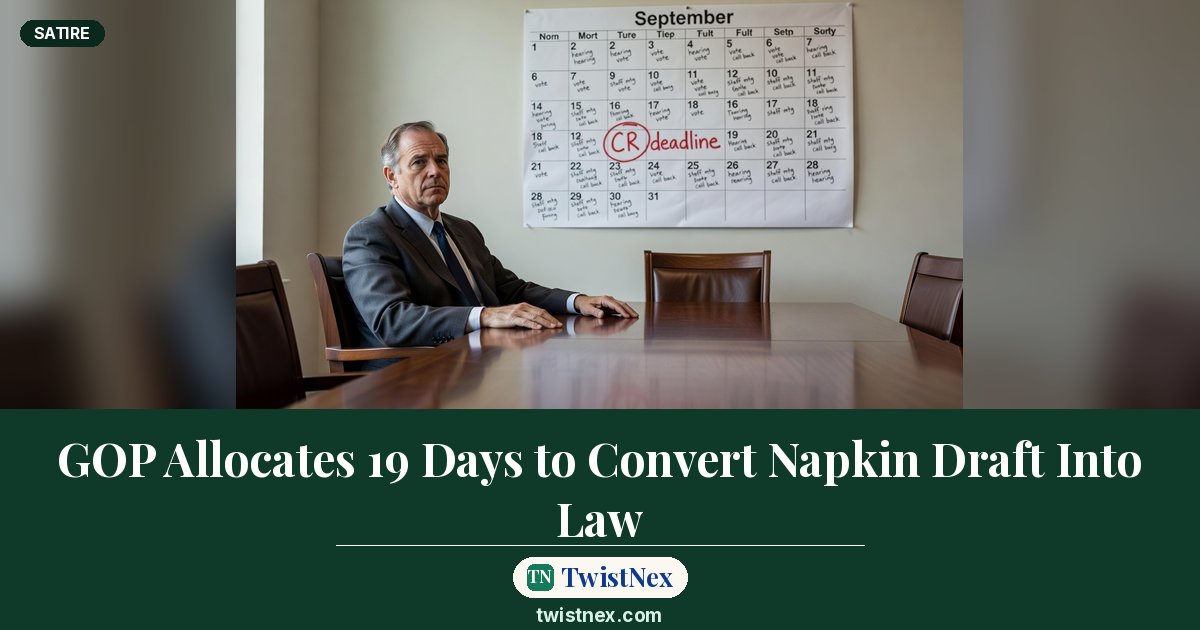
House Republicans returned from August recess with a September calendar already double-booked for a continuing resolution, reconciliation instructions, and whatever else fits between 2 a.m. votes and 6 a.m. panic texts.
Leadership set aside three full days for the stopgap spending measure, two days for amendments no one will read, and one afternoon for a procedural fight that will be settled by a coin flip in the cloakroom.
A senior aide described the timeline as tight but manageable if every member skips lunch and at least two committee chairs agree to stop introducing new bills during the actual vote.
Speaker Johnson’s office released a one-page schedule printed in size-8 font that lists 14 procedural hurdles before any actual money moves. Staffers have been instructed to carry red pens for last-minute changes and black pens for pretending the changes were always there.
Senate Majority Leader Schumer’s counterpart offered to help by promising Democrats will only use the CR as leverage on exactly seven unrelated issues, down from the usual twelve.
The Congressional Budget Office has been asked to score the measure in under 48 hours, a request the agency met by assigning its entire staff and one intern who still believes in overtime pay.
At a closed-door meeting, members were told the only acceptable outcome is passage before October 1, after which the government would enter a period of “creative accounting” that everyone has agreed never to call a shutdown.
One freshman asked whether the bill could simply be extended from last year with white-out. Leadership replied that white-out had already been allocated to the debt-ceiling negotiations.
By December the same members will be asked to repeat the process with even less time and even more amendments, a prospect described by leadership as “the system working as intended.”