Texas Office of Conflicting Jurisdictions Delays Baby Ruling Until Forms Reach Consensus
Satire: TwistNex is a satirical publication. This is fiction inspired by real news. Quotes, experts and statistics are invented and must not be cited as fact.
Texas court treats a signed surrogacy contract like a timeshare agreement no one read past page three.
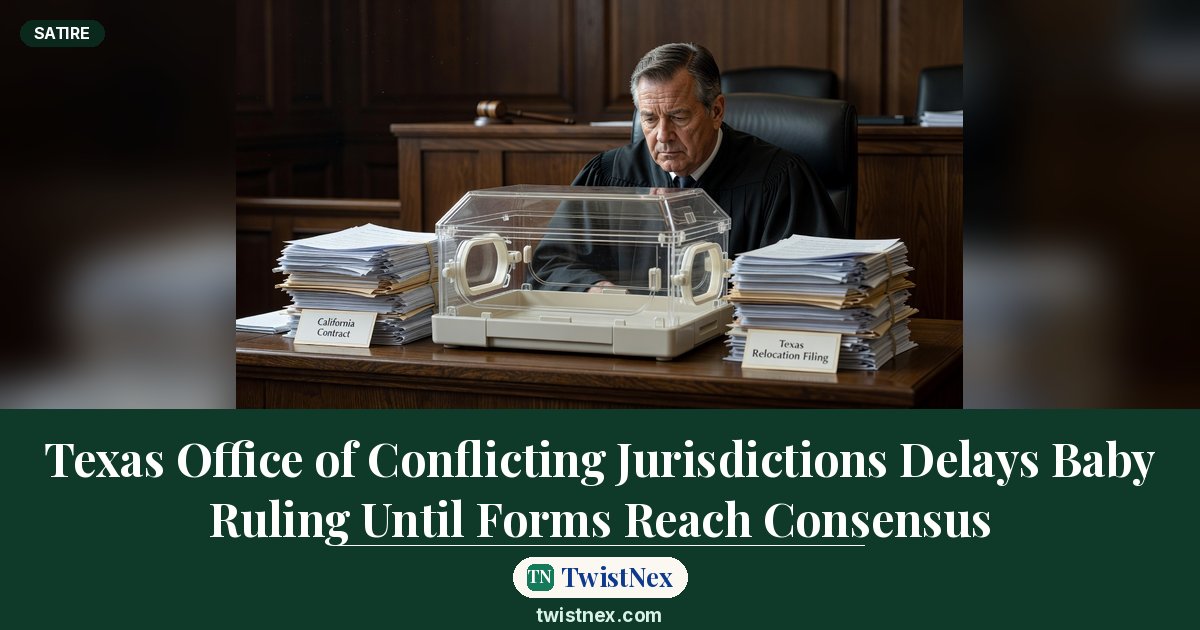
A Dallas family court spent three hours debating whether a signed surrogacy contract still applies after the carrier relocated to Texas and decided she wanted the child after all.
The California couple, who had already paid for prenatal care and the newborn’s heart surgery, sat through testimony that included the surrogate’s claim of sudden emotional attachment formed during her drive across state lines.
Chief Coordinator of Multi-State Reproductive Paperwork at the Texas Office of Conflicting Jurisdictions explained the delay by citing unresolved questions of domicile, medical billing responsibility, and which state’s version of “intent” gets priority when both parties signed different forms.
The surrogate’s attorney argued the original agreement became void the moment she crossed into Texas, while the couple’s lawyer countered that the contract contained a clause covering exactly this scenario plus two others no one had imagined.
A court clerk read aloud the restraining order keeping the infant in a monitored hospital unit until further notice, noting that visitation would be limited to scheduled windows and one shared copy of the medical chart.
Outside the courtroom the California couple declined comment, while the surrogate told reporters the baby “deserves to stay with the person who carried it, regardless of prior arrangements or current medical invoices.”
The judge scheduled the next hearing for a date when the infant might still be recovering from its second procedure and all parties promised to bring updated travel receipts.