Airline Requires Crews to Log Millisieverts on Lost Luggage Forms After Cosmic Ray Ruling
Satire: TwistNex is a satirical publication. This is fiction inspired by real news. Quotes, experts and statistics are invented and must not be cited as fact.
French court confirms what frequent flyers already suspected: the sky itself is now a line item on the hazard form.
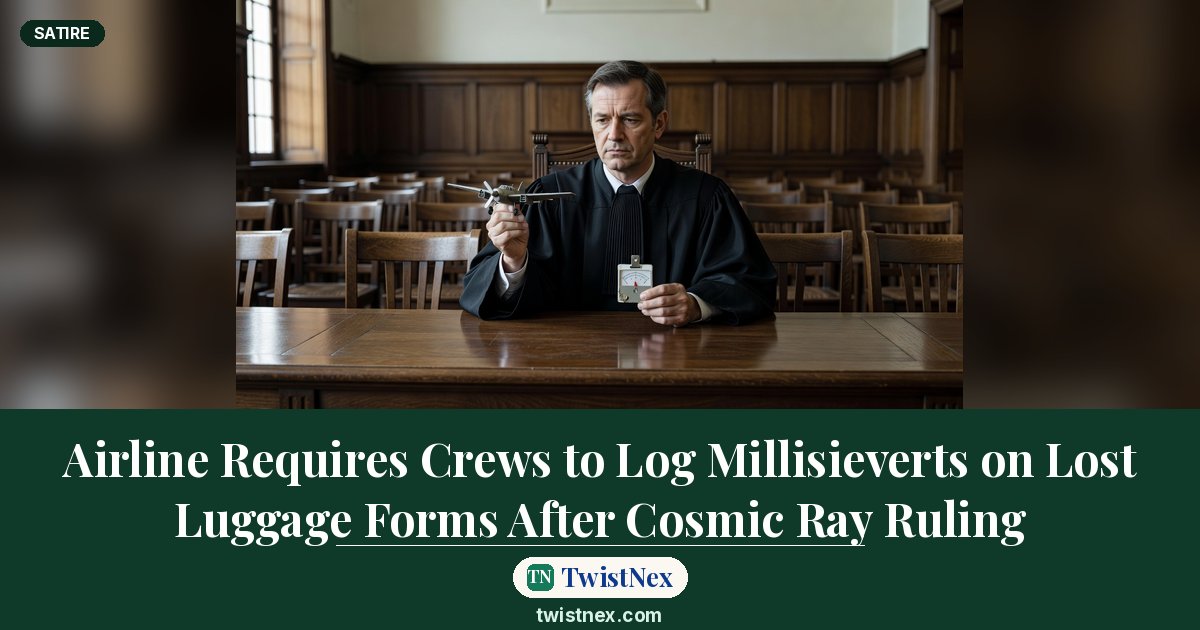
A Paris court has ruled that cosmic radiation exposure during long-haul flights counts as an occupational disease after former Air France stewardess Sophie Lainault developed breast cancer.
The decision cites her 26,400 hours above 30,000 feet and the airline's failure to provide lead-lined aprons or shorter polar routes. Airline spokespeople called the ruling "an unexpected development in the ongoing conversation about employee well-being."
A newly created position, Deputy Undersecretary for Ionizing Particles at the Directorate of In-Flight Toxicology, immediately issued guidance requiring crews to log cumulative millisieverts on the same form used for lost luggage claims.
Management responded by scheduling a single two-hour training module that covers both radiation shielding and the correct way to refill the coffee urn. Crew members who exceed the new annual limit will receive a commemorative pin and mandatory reassignment to the Paris–Newark red-eye.
When asked how the airline plans to reduce exposure, one executive replied, "We are exploring all options, including flying lower when fuel prices allow and reminding passengers that their phones also emit radiation."
The ruling stops short of ordering actual protective equipment, noting that any such purchase would require approval from the Department of Things That Cost Money and Might Look Bad in an Annual Report.
Lainault's lawyer described the outcome as "a small step toward acknowledging that the sky is, in fact, not entirely harmless."
Air France has appealed on the grounds that cosmic rays predate the company and therefore cannot be considered work-related.