Russia Threatens Lumber Restrictions Over Canada's Supply of Recon Drones
Satire: TwistNex is a satirical publication. This is fiction inspired by real news. Quotes, experts and statistics are invented and must not be cited as fact.
Russia calls Canada a warmonger for arming Ukraine with drones, proving that only some countries are allowed to sell weapons during invasions.
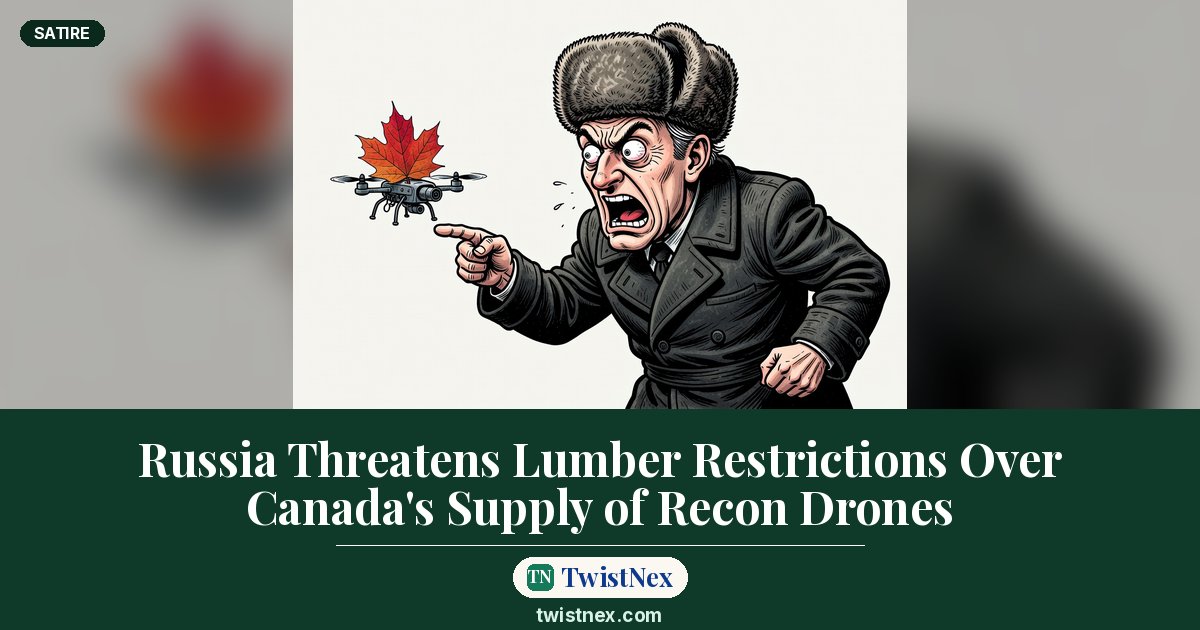
In a move that surprised precisely no one familiar with great-power projection, Russia has condemned Canada as a dangerous warmonger for agreeing to supply Ukraine with surveillance drones. The Kremlin framed the transaction as reckless escalation, warning that Ottawa’s actions could destabilize the region in ways only Moscow is permitted to do.
Foreign Ministry spokesperson Maria Zakharova described the Canadian drones as “instruments of aggression disguised as maple-leaf benevolence.” She added that any further deliveries would force Russia to respond “proportionally and with the full weight of our diplomatic thesaurus.” Analysts interpreted this as a threat to issue additional strongly worded statements and possibly restrict imports of Canadian lumber.
Canadian officials responded with the diplomatic equivalent of a shrug. Defence Minister Bill Blair noted that the drones are unarmed and intended solely for reconnaissance, a clarification Russia dismissed as “typically Canadian passive-aggression.” Kremlin-aligned commentators suggested Ottawa’s real goal is to provoke Moscow into overextending its resources, a strategy apparently devised during a national meeting of beaver strategists.
The episode has revived long-standing debates about whose military exports qualify as defensive and whose qualify as existential threats. A spokesperson for the Russian embassy in Ottawa clarified that only weapons supplied by countries currently not on Russia’s list of adversaries may be considered legitimate. Countries on the list are required to supply nothing except apologies.
Economists at the Institute for Selective Outrage estimated that sustained Canadian drone deliveries could cost Russia up to three additional press releases per week. They recommended Moscow offset these losses by nationalizing the concept of hypocrisy itself, an asset long considered Russian intellectual property.
As tensions simmer, both sides have agreed to continue the time-honoured tradition of denouncing each other’s actions while quietly updating their respective arms catalogues. Observers expect the next round of accusations to focus on Canada’s alleged plan to equip Ukraine with winter clothing rated for Siberian conditions, a development Russia has already labeled “climate warfare.”