Kinshasa, Belfast Seek Ban on Gatherings of Four Without Minister's OK
Satire: TwistNex is a satirical publication. This is fiction inspired by real news. Quotes, experts and statistics are invented and must not be cited as fact.
When crowds protest in Kinshasa or riot in Belfast, the solution is always the same: rewrite the rules so the crowds can't exist.
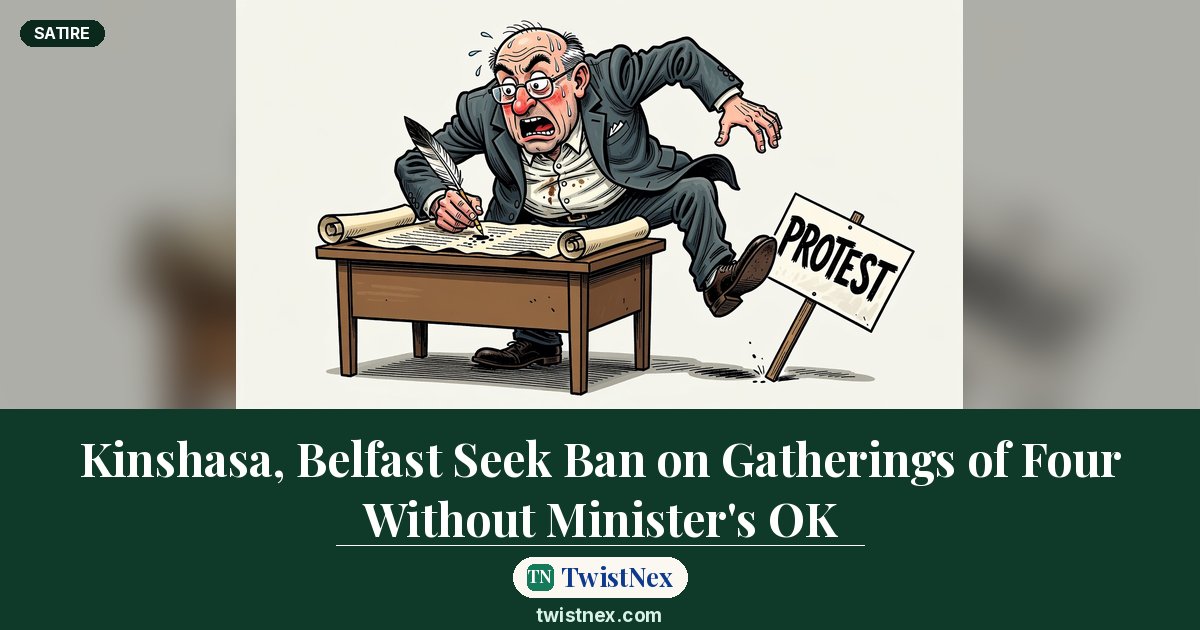
Faced with fresh unrest in Kinshasa and Belfast, senior officials in both places have concluded that the constitution itself needs urgent amendment to prevent future demonstrations from happening at all.
In DR Congo, hundreds took to the streets of the capital to oppose planned changes to term limits. Within hours, security forces and protesters clashed. In Belfast, a knife attack was followed by crowds targeting minority neighborhoods. Rather than address housing shortages or judicial backlogs, spokespeople in both capitals announced that new constitutional language would simply redefine public assembly as a potential threat to public order.
A joint working group of constitutional lawyers is already circulating draft clauses that would require any gathering of more than three people to obtain prior approval from a panel that includes the minister whose policies are being protested. "This is not censorship," explained one drafter who asked not to be identified. "It is constitutional hygiene."
Independent analysts note that the proposed wording also contains helpful carve-outs for officially sanctioned rallies celebrating the government. Statistics produced by the working group claim that 100 percent of violent incidents occur at unsanctioned events, a finding described as "statistically perfect" by the officials who commissioned it.
Critics argue the changes might limit avenues for peaceful dissent. Supporters reply that peaceful dissent can be conducted quietly at home, preferably in writing submitted through proper channels that have not yet been invented. The revised constitutions are expected to be ready for approval by the same bodies that proposed the original changes.
If the measures pass, future outbreaks of public feeling will be classified in advance as constitutional violations, sparing everyone the inconvenience of deciding what caused them.