Polish Authorities Classify Five-Bullet Shooting as Direct Cultural Feedback
Satire: TwistNex is a satirical publication. This is fiction inspired by real news. Quotes, experts and statistics are invented and must not be cited as fact.
Russian artist’s Putin-Stalin mashup receives armed Belarusian peer review in Poland, proving some caricatures age poorly within 72 hours.
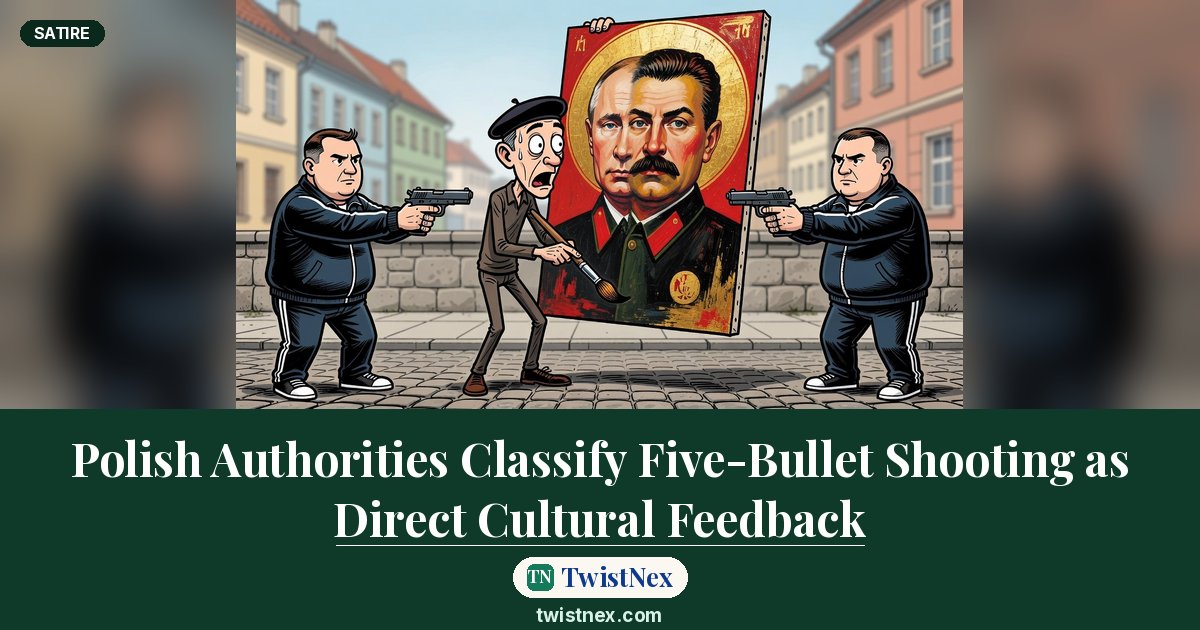
In the quiet Polish border town of Biała Podlaska, local authorities are treating the fatal shooting of Russian artist Robert Kuzovkov as an unusually direct form of cultural feedback. Kuzovkov, who also worked under the name Semyon Skrepetsky, had been displaying an icon-style portrait outside the Russian embassy in Berlin just three days earlier, merging Vladimir Putin’s features with those of Josef Stalin. Within seventy-two hours, five bullets provided what investigators describe as “immediate and unambiguous commentary.”
Polish prosecutors report that two Belarusian nationals have been detained in connection with the attack, which took place on Monday. The method—precise shots including one to the head—has prompted observers to question whether the assailants were dispatched for their marksmanship or simply their taste in portraiture. Neither suspect has offered a public statement, leaving art critics to speculate whether the response constitutes a new category of performance piece.
A spokesperson for the Lublin prosecutor’s office confirmed the basic facts without elaboration, noting only that the investigation continues. Meanwhile, an unnamed Russian diplomatic source, speaking on condition of anonymity, suggested that embassies are increasingly fielding requests for “extended exhibition feedback” when traditional channels prove insufficient. Independent monitors tracking political violence have recorded no comparable surge in armed art appraisal, but acknowledge that the sample size remains small.
Advocates for exiled Russian artists say the incident highlights the risks of working in caricature rather than oil on canvas. One anonymous gallery owner in Warsaw proposed that future exhibitions include disclaimers advising against iconographic treatments of current heads of state. Whether this constitutes prudent risk management or simply prudent risk avoidance remains under discussion among curators who prefer their openings blood-free.