State Dept Returns Ebola Funding Requests with Note Reading 'Ask the Europeans'
Satire: TwistNex is a satirical publication. This is fiction inspired by real news. Quotes, experts and statistics are invented and must not be cited as fact.
America's new Ebola plan: strategic patience, motivational Zoom calls, and hoping someone else volunteers.
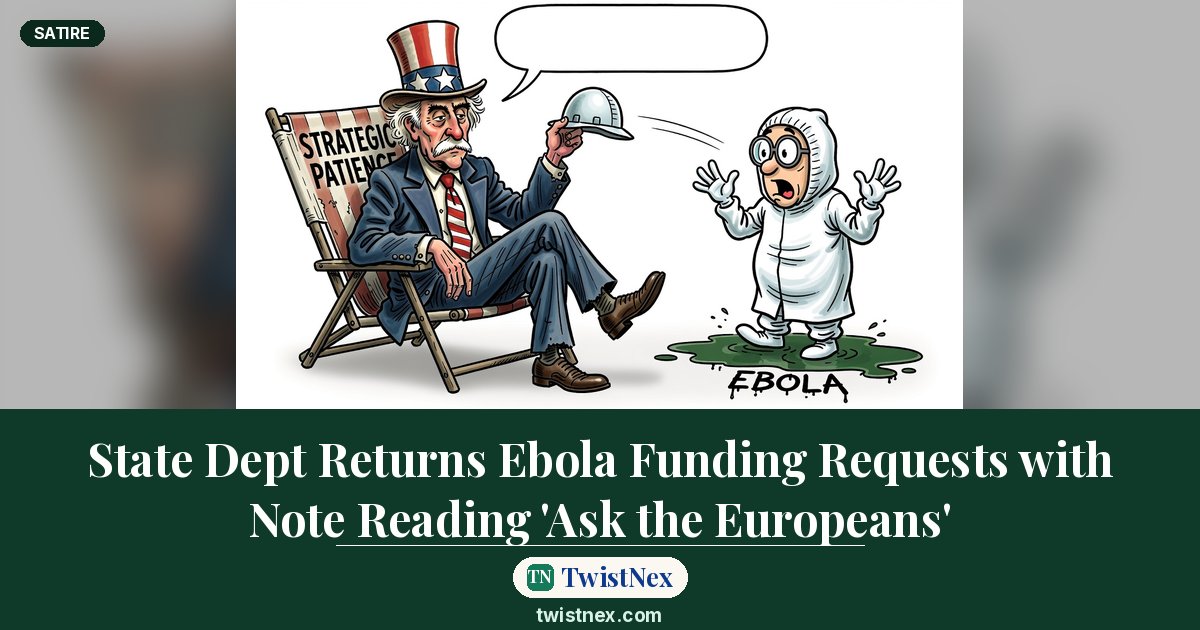
The United States, once the country that dispatched epidemiologists at the first sign of hemorrhagic fever, has quietly decided that leading the fight against Ebola is someone else's problem. Senior officials now describe their strategy as "strategic patience," which in practice means monitoring the outbreak from a safe distance while hoping a more enthusiastic nation volunteers.
State Department memos obtained by TwistNex reveal that funding requests for rapid-response teams were returned with handwritten notes reading "Ask the Europeans" and "Check with the vaccine people." One memo suggests the administration is considering a public-private partnership model in which a major streaming service might sponsor contact-tracing efforts in exchange for branded hazmat suits.
"We remain fully committed to global health security," said a senior official who spoke on condition of anonymity because he had already left for the airport. "We just think leadership looks different in 2024. More like cheerleading from the stands."
Analysts note that America's new posture has already produced measurable results: confusion. The World Health Organization reports receiving three separate U.S. inquiries asking whether the agency had "any spare experts lying around." A fictional internal poll circulated among health attaches found that 67 percent of allied governments believe the United States is currently experiencing "a temporary leadership outage" while 33 percent assume the entire concept has been outsourced to a consulting firm.
The most ambitious proposal so far involves inviting mid-sized nations to form an "Ebola Consortium of the Willing," with the U.S. supplying motivational Zoom calls and, if budgets allow, a single PowerPoint slide. Observers say the approach marks a clean break from the era when Washington treated infectious-disease outbreaks as opportunities to demonstrate competence rather than opportunities to demonstrate plausible deniability.
As one unnamed strategist put it, "If the virus wants to be taken seriously, it will have to schedule a meeting with whoever shows up."