Unpublished Simulation Finds Labour Could Hold Leadership Votes Every Six Months With Loser Named Deputy PM
Satire: TwistNex is a satirical publication. This is fiction inspired by real news. Quotes, experts and statistics are invented and must not be cited as fact.
Starmer is ready to give Andy Burnham a cabinet job and then run against him for the right to hand it over.
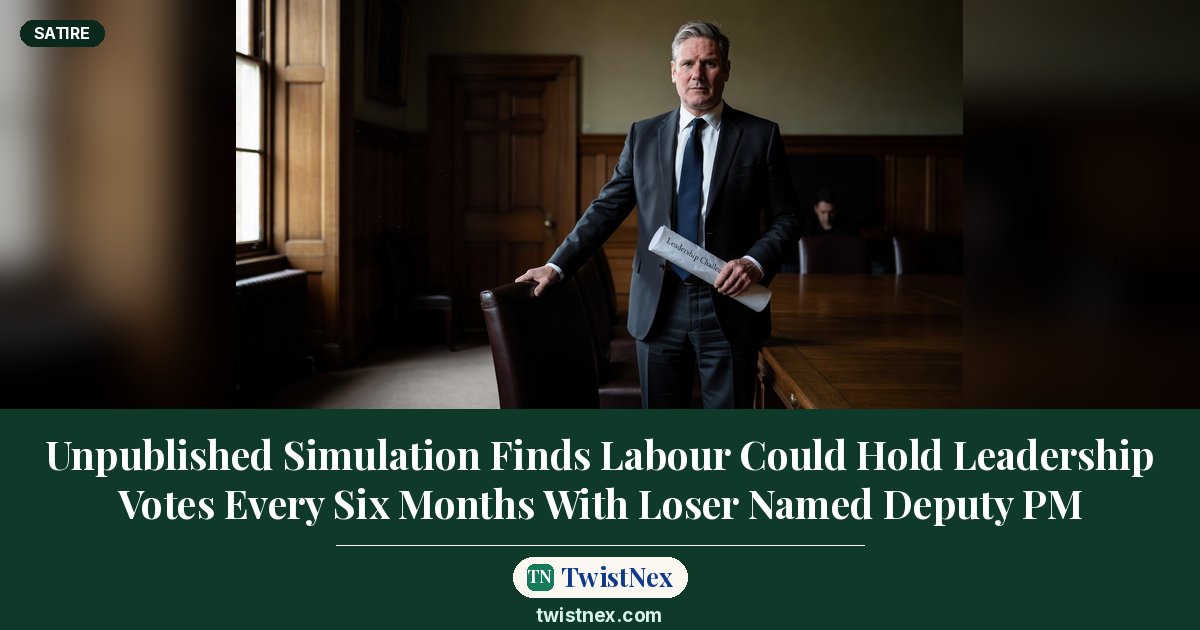
Prime Minister Keir Starmer has confirmed he will personally contest any Labour leadership challenge from Andy Burnham while simultaneously preparing a cabinet position for the same man, describing the Greater Manchester mayor as a “huge asset” who can help the party “pull together.”
Speaking from the G7 summit in France, Starmer warned that a contest would plunge the party into chaos yet insisted he would not walk away. He also made clear that, should Burnham prevail in the Makerfield byelection, suitable ministerial responsibilities would be identified for him immediately.
The dual-track approach is already being studied by constitutional experts as a possible model for future internal disputes. One unpublished simulation suggests the party could hold a leadership election every six months, with the loser automatically appointed deputy prime minister to avoid any disruption to government business.
A senior Labour source, speaking on condition of anonymity, confirmed the prime minister views the arrangement as “mature” and “grown-up,” adding that offering a rival a desk in the same building removes the need for either man to rent an office elsewhere. “It’s efficient,” the source said.
Burnham has not yet commented on the proposed job offer, though allies say he is still deciding whether to accept the cabinet post before or after defeating Starmer in the contest both men appear determined to hold.
Whitehall officials have begun quietly mapping which departments could absorb a high-profile newcomer without requiring any existing minister to move out. One option under discussion is the creation of a new Ministry for Parallel Leadership, whose sole brief would be to manage the relationship between the sitting prime minister and the person running against him.
Polling conducted for internal party use shows voters remain largely relaxed about the arrangement, with 41 percent describing it as “normal politics” and 29 percent admitting they can no longer tell which man is currently in charge.