Russia Sets Graduate Quota to Avoid Excess Citizens Able to Read Policy Documents
Satire: TwistNex is a satirical publication. This is fiction inspired by real news. Quotes, experts and statistics are invented and must not be cited as fact.
Russia just announced it has produced too many college graduates and would like everyone to calm down and stop learning so much.
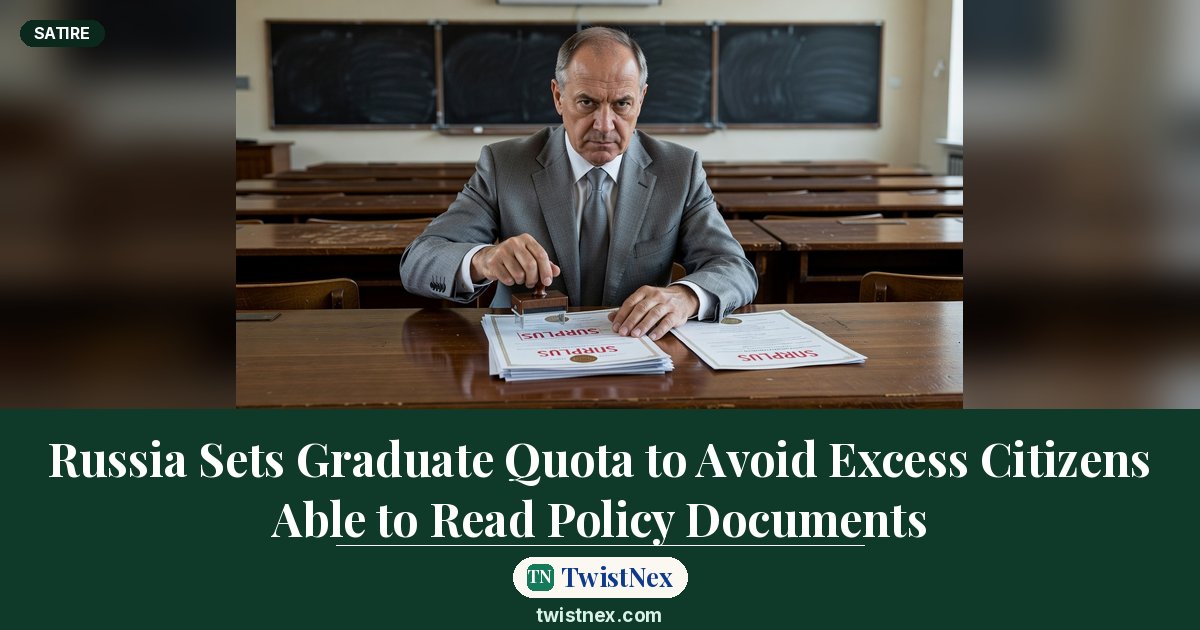
Russia’s education minister has declared that the country no longer requires so many university graduates, warning that continued overproduction of degree-holders risks creating an unnecessary surplus of people who can read policy documents without assistance.
The announcement, delivered with the calm authority of someone explaining why the ministry now needs fewer pencils, follows internal calculations showing the state possesses sufficient trained professionals to staff its preferred number of think tanks, oil companies, and press offices. Additional graduates, officials noted, could lead to awkward questions about why certain economic indicators remain classified.
“We have reached optimal levels of higher education,” the minister stated at a briefing attended only by state media. “Any further increase would constitute an inefficient allocation of national brain resources. Citizens are encouraged to explore alternative career paths such as manual labor, patriotic service, or simply not inquiring too deeply.”
Analysts close to the Kremlin confirmed the policy aligns with long-term demographic goals. One source, speaking on condition of anonymity because he once attended a seminar, estimated that Russia currently requires roughly 40 percent fewer people capable of completing a five-year degree program. The excess capacity, he suggested, could be redirected toward more pressing national needs, including the operation of heavy equipment and the maintenance of historical silence.
Universities have been instructed to adjust enrollment targets accordingly. Several institutions have already begun pilot programs offering certificates in “non-degree studies” and advanced workshops on accepting the situation. Enrollment in fields previously associated with independent thought is expected to decline sharply, while programs in loyalty studies and equipment operation are projected to expand.
Opposition figures described the move as a pragmatic admission that the state’s preferred citizen profile does not require advanced literacy. The ministry declined to comment further, citing a new policy against releasing statements that might require footnotes.