HHS Extends School Lunch Eligibility to One Million Frozen Embryos in Storage
Satire: TwistNex is a satirical publication. This is fiction inspired by real news. Quotes, experts and statistics are invented and must not be cited as fact.
The government now wants to give frozen embryos school lunches and tax credits—because nothing says fiscal responsibility like daycare in a cryotank.
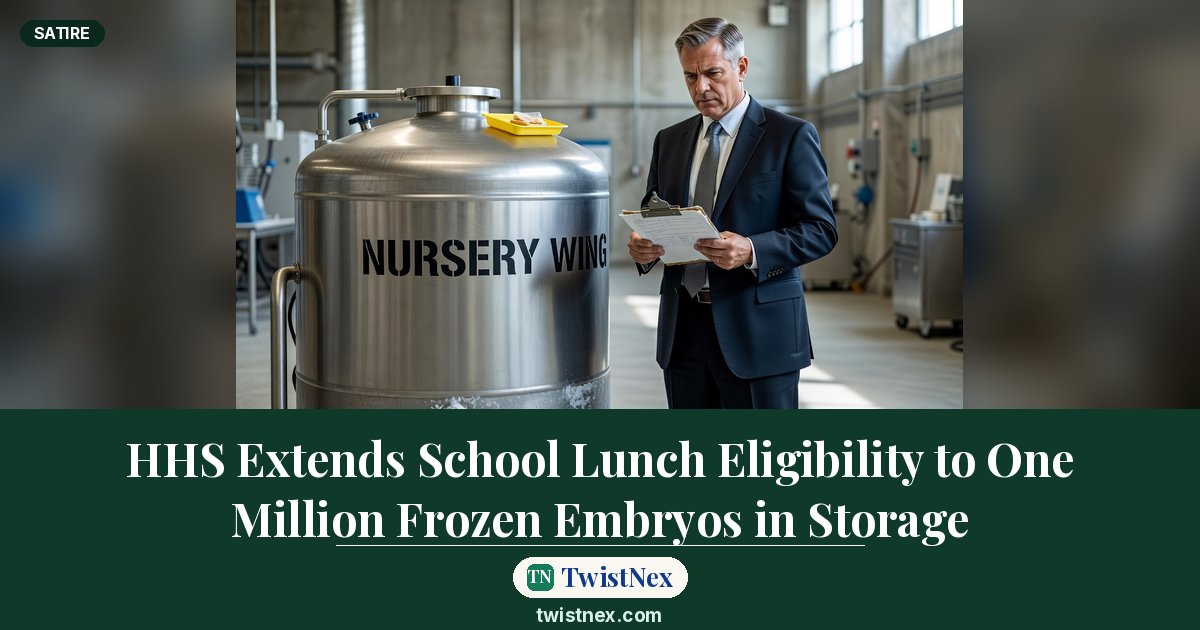
The Department of Health and Human Services quietly rewrote a grant notice last week to describe frozen embryos as “children,” turning a modest embryo-adoption awareness program into the latest front in the administration’s campaign for fetal personhood.
Officials insist the change is merely linguistic housekeeping. Internal memos, however, reveal staff already drafting follow-on rules that would let embryos qualify for child tax credits, early-intervention services, and federally subsidized daycare slots inside cryogenic storage facilities. One draft appendix proposes installing miniature desks and juice boxes beside each Dewar tank.
“This is about protecting the most vulnerable among us,” said a senior HHS appointee who declined to be named because he was busy measuring an embryo for a booster seat. “If we’re serious about life, we can’t draw an arbitrary line at implantation or birth or, frankly, at room temperature.”
Legal observers note the move could complicate everything from inheritance law to airline seating policies. Airlines are reportedly studying whether embryos require their own tickets or may travel as carry-on dependents. Fertility clinics, meanwhile, have begun posting signs warning that “unattended children will be reported to Child Protective Services,” a category that now includes any vial left too long on the counter.
Budget analysts calculate that recognizing the estimated one million frozen embryos as minor dependents would instantly add several billion dollars in new entitlements. The Office of Management and Budget has responded by commissioning a study on whether liquid-nitrogen storage counts as foster care.
Administration allies dismiss the logistical questions as minor details to be worked out after the next election. Critics inside the agency describe the policy as an elegant solution to the problem of having no actual children to protect: simply declare that the children already exist, on ice, awaiting their first report cards.