Supreme Court Clarifies 'Temporary' Means Until President Gets Bored
Satire: TwistNex is a satirical publication. This is fiction inspired by real news. Quotes, experts and statistics are invented and must not be cited as fact.
Supreme Court confirms that fifteen years of legal residency is still just a suggestion.
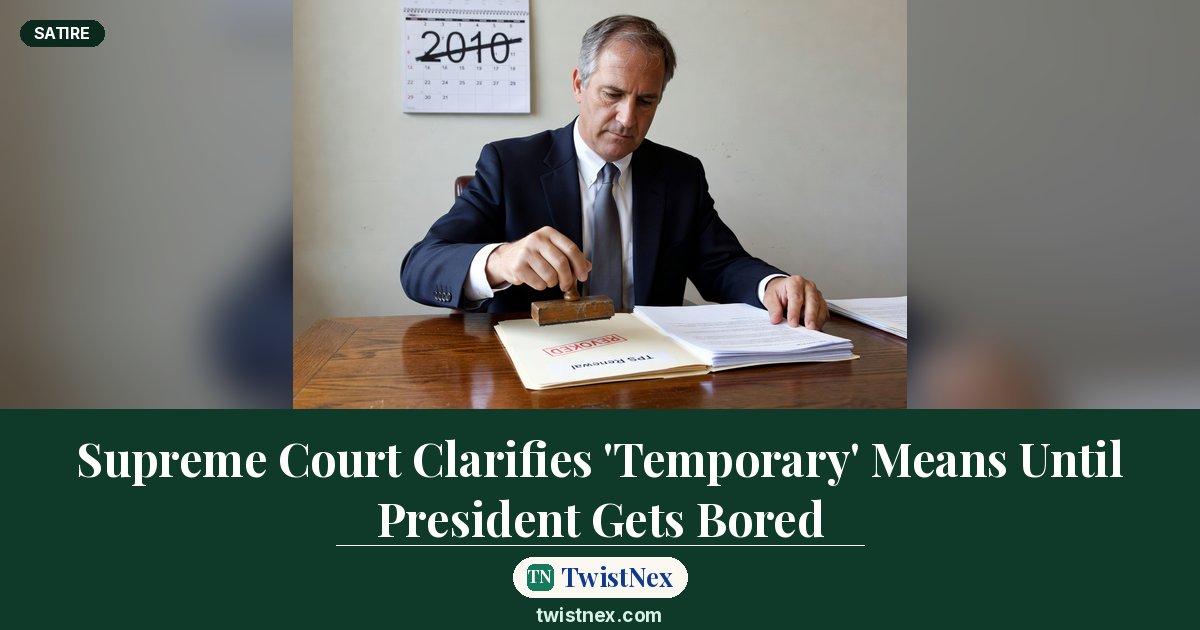
The Supreme Court ruled Thursday that the Trump administration may cancel a decade-old humanitarian program protecting roughly 100,000 Haitians and thousands of Syrians who have lived, worked, and paid taxes in the United States since the program began. Officials described the decision as a routine exercise of executive discretion over immigration status.
Administration lawyers argued that Temporary Protected Status was never intended to become permanent simply because people had followed every rule for fifteen years. A senior Justice Department official, speaking on background, noted that the program was always labeled temporary and that courts should not interfere when an administration decides the temporary period has ended. "We've been very clear," the official said. "Temporary means until we say otherwise."
The ruling also allows border agents to turn away asylum seekers before they can request protection, a policy the administration had previously tested with mixed results. Legal analysts close to the White House estimated that the combined decisions would free up roughly 47 bureaucrats to focus on more pressing national-security threats, such as reviewing whether any of the affected individuals had once posted something mildly critical of the president on social media.
Immigration experts outside government expressed surprise that residency of this length could be treated as provisional. One academic, Professor Linda Voss of Georgetown, observed that the court had effectively created a new category of legal status: "conditionally American until further notice." The administration immediately began drafting guidance for case officers on how to calculate when a person's welcome has officially expired.
White House sources indicated that similar reviews of other long-standing protections are already underway, though they declined to name the next nationalities under consideration. For now, the message to current holders of Temporary Protected Status appears straightforward: the protection was real, just not necessarily lasting.