Supreme Court Requires TPS Applicants to Swear They Will Not Vote
Satire: TwistNex is a satirical publication. This is fiction inspired by real news. Quotes, experts and statistics are invented and must not be cited as fact.
Supreme Court makes Haitian workers in Ohio pick between legal status and the ballot box in one tidy package deal.
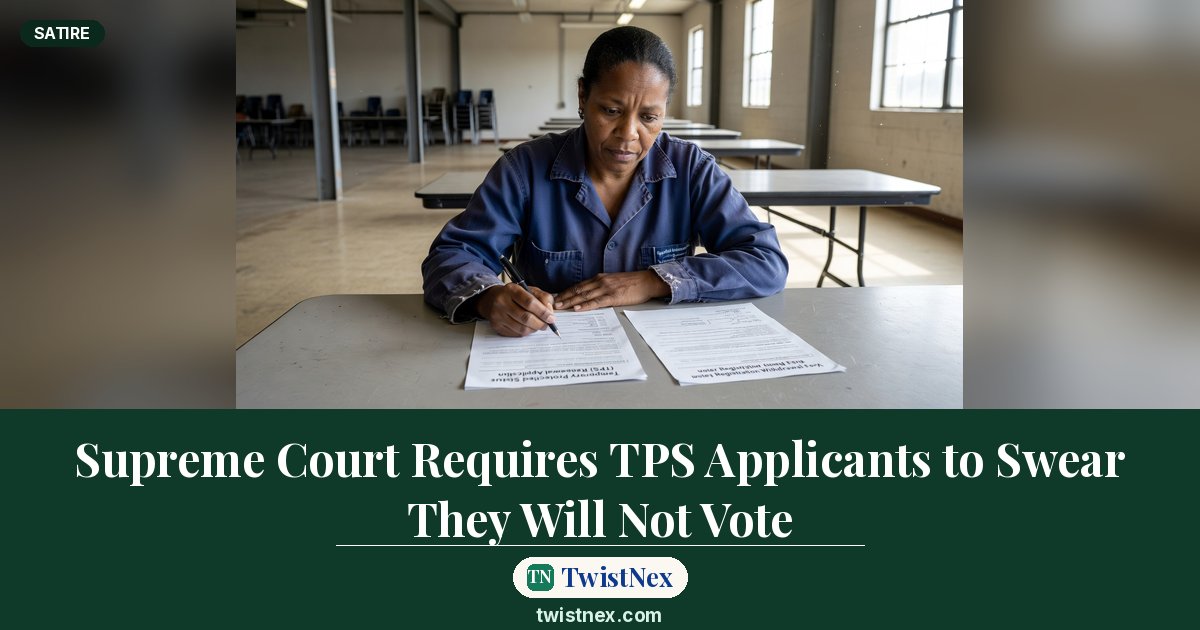
The Supreme Court this week delivered a paired set of rulings that treat temporary protected status and voting access as two sides of the same coin: if you want one, you apparently must forfeit the other.
Under the new framework, roughly 500,000 Haitians nationwide lose legal work authorization unless their home states first enact the exact voting restrictions the Court simultaneously green-lit as constitutional. Ohio officials have already begun drafting the required paperwork, which now includes an affidavit swearing the applicant has not registered to vote and promises never to do so.
Administration sources described the logic as elegant. "We are simply aligning immigration relief with the new baseline for civic participation," one unnamed official said. "If a person cannot be trusted to cast a ballot under the revised standards, it follows they should not be trusted to renew a work permit either."
Springfield city leaders, who credit Haitian residents with reopening shuttered factories and stabilizing the school district, expressed quiet confusion. "We were told to welcome the workforce," Mayor Helen Smith noted in a prepared statement. "We were not told the workforce would later be asked to choose between papers and a polling place."
Legal analysts expect the combined effect to reach well beyond Haitians. Any group holding TPS could face identical conditions once states update their election codes to match the Court's new latitude. Early drafts in several legislatures already list TPS holders as a presumptive category for enhanced ID requirements and reduced polling hours.
The Court offered no timetable for further clarification, noting only that future cases would be evaluated on the same "coherent national policy" standard. For now, applicants are advised to check both boxes: one confirming they are leaving, and one confirming they are not coming back to vote about it.