Pentagon Classifies Rocket Deaths as Moderate Regional Disagreement
Satire: TwistNex is a satirical publication. This is fiction inspired by real news. Quotes, experts and statistics are invented and must not be cited as fact.
US military now classifies Iranian attacks as routine weather, because acknowledging patterns would require actual decisions.
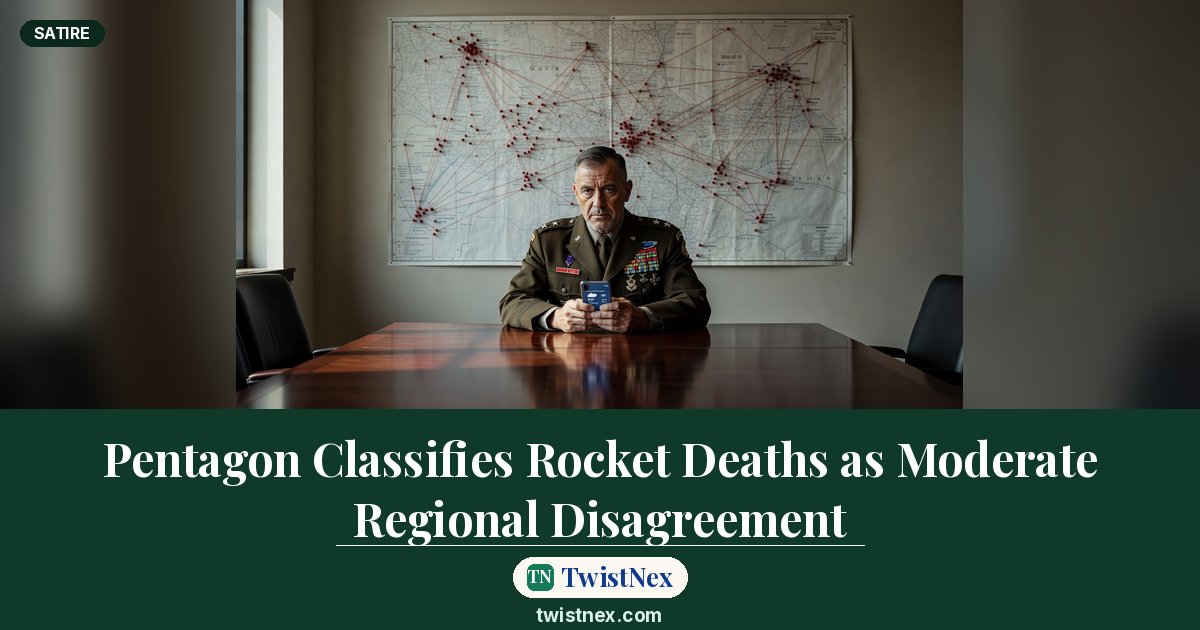
The US military announced Wednesday that another American soldier has died in Iraq following an Iranian-backed attack, marking the second such incident in as many days after two others were killed in Jordan.
Officials described the strikes as part of an established pattern now treated with the same operational detachment once reserved for sandstorms or flash floods. “We have adjusted our posture to account for these predictable environmental factors,” said a senior defense spokesperson who asked not to be named while speaking in the passive voice.
Internal briefings reportedly include color-coded alerts that escalate from “light incoming” to “moderate regional disagreement,” with units advised to continue scheduled maintenance and morale activities unless winds exceed 40 knots or shrapnel density reaches critical thresholds. A fictional after-action memo circulating among mid-level officers suggests the department is exploring actuarial tables that factor rocket trajectories the way insurance companies price hail damage.
Defense analysts note that this approach allows leadership to maintain existing force levels and procurement schedules without triggering the cumbersome political process once required for each new casualty. “It’s really about efficiency,” explained a retired general who now consults for a firm that sells both armored vehicles and weather apps. “You wouldn’t cancel a picnic every time it rains in the Hindu Kush.”
Congressional oversight committees have scheduled hearings on the matter for a date to be determined after the next funding cycle, provided no additional “atmospheric events” interfere with travel plans.
The policy has drawn quiet praise from budget offices for reducing the paperwork associated with each individual loss while preserving the strategic ambiguity that has defined the region for two decades.