White House Insists New Tariffs Legal Because They Added Phrase 'This Time It's Different'
Satire: TwistNex is a satirical publication. This is fiction inspired by real news. Quotes, experts and statistics are invented and must not be cited as fact.
25 states just sued to block tariffs that are literally the old illegal tariffs with new letterhead, because apparently 'rebrand it' counts as legal strategy now.
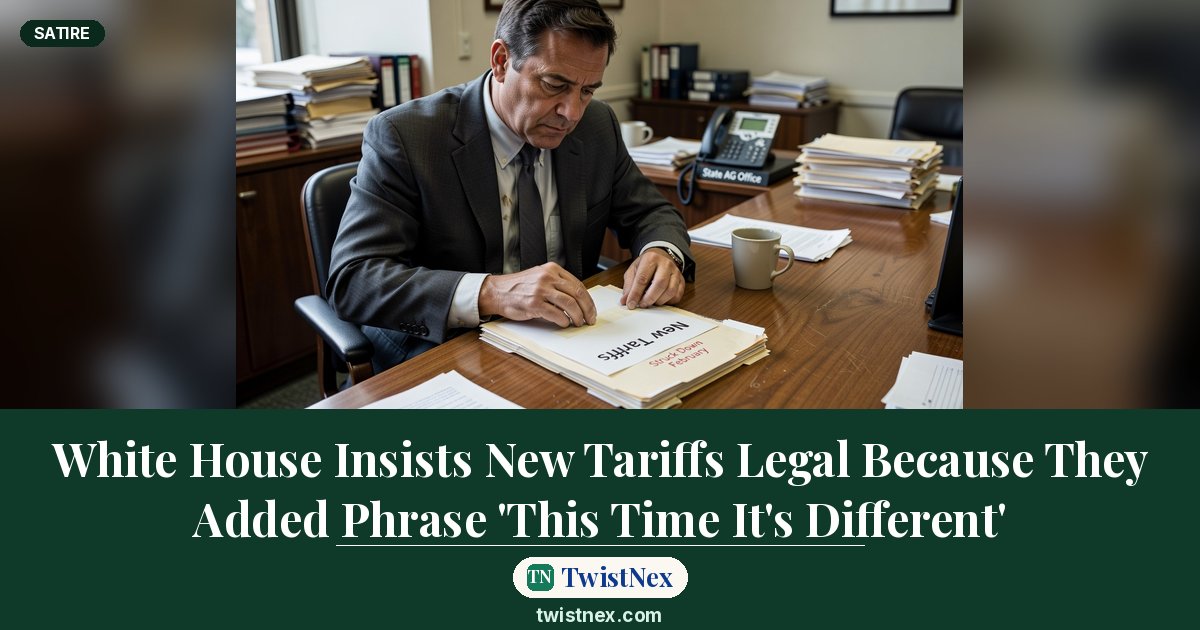
A coalition of 25 states has filed suit against the Trump administration, arguing that the latest round of 10 to 12.5 percent tariffs on goods from more than 60 countries is simply the previous global duty with different paperwork attached. The states claim the move violates the Supreme Court ruling from February that struck down the earlier version, a detail the administration appears to have treated as a minor formatting suggestion.
Court documents describe the new tariffs as an "arbitrary and capricious" attempt to keep import taxes alive under a different name. Two small businesses have joined the case, noting that their supply chains were already priced for the old illegal rates and are now priced for the new illegal rates, creating a seamless continuity of cost without any corresponding legality.
The administration maintains the tariffs target forced labor and unfair practices. Critics observe that the list of targeted countries expands and contracts with each news cycle, suggesting the policy functions less as targeted enforcement and more as an ongoing game of economic musical chairs.
Inside the Court of International Trade, lawyers for the states presented charts showing the new tariff language is nearly identical to the struck-down version, except for the addition of the phrase "this time it's different." Administration officials declined to comment on whether that phrase carries legal weight.
If the suit succeeds, the tariffs will be paused until the next round of tariffs can be drafted. Analysts expect that round to arrive shortly after the current one is blocked, preserving the familiar rhythm of announcement, lawsuit, and re-announcement that has defined recent trade policy.