Treasury Nominee Declares K Economy Over After Bottom Arm Airlifted Into Upper Bracket
Satire: TwistNex is a satirical publication. This is fiction inspired by real news. Quotes, experts and statistics are invented and must not be cited as fact.
Washington solved the K-shaped economy the same way it solves everything: by announcing the inconvenient half no longer counts.
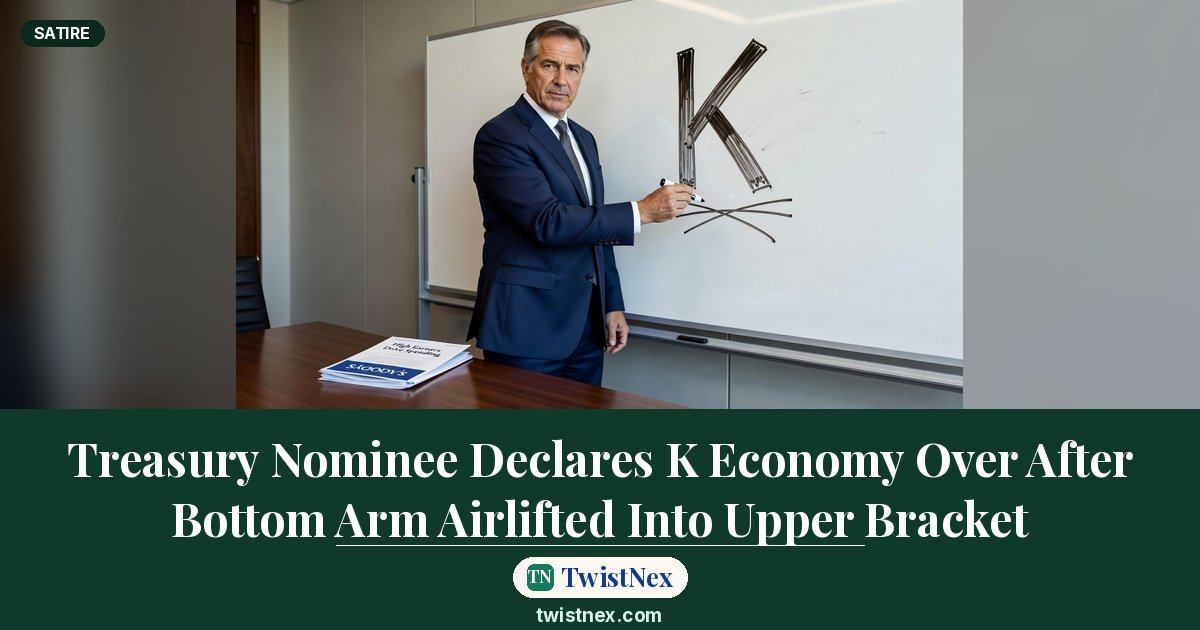
Treasury Secretary nominee Scott Bessent announced this week that the K-shaped economy is finished, effectively declaring victory over the awkward reality that rich households kept spending while everyone else cut coupons.
Moody’s chief economist Mark Zandi immediately countered that the shape remains “firmly intact,” with high earners still driving all meaningful consumption. The competing statements have left Americans unsure whether their personal finances now form an I, an L, or simply a sad vertical line pointing down.
Administration allies insist the lower arm of the K has been airlifted into the upper arm through unspecified market forces. When pressed for details, one unnamed official compared the process to “a very successful game of economic musical chairs where the music never stops for people who already own chairs.”
Zandi’s data shows the top 20 percent continue to account for nearly half of all spending, while lower-income households remain pinned to the bottom stroke of the letter. Bessent’s camp dismissed the figures as “so last quarter,” suggesting the economy has since evolved into a more modern letter—possibly a Q or an ampersand that somehow benefits luxury real estate.
Economists unaffiliated with either side have begun sketching new letters altogether. One proposed an “M” in which the middle class briefly appears before vanishing again. Another suggested the current shape is best described as “K but with the bottom half drawn in disappearing ink.”
For now the debate continues in the usual Washington manner: one side claims the problem is solved, the other side shows receipts, and the public is invited to decide which narrative feels more expensive at the grocery store.