Virginia State Now Requires Advance Reservations for Seward Hall Closets
Satire: TwistNex is a satirical publication. This is fiction inspired by real news. Quotes, experts and statistics are invented and must not be cited as fact.
One suspect treated a dorm closet like a luxury suite for 14 hours while police conducted the world’s slowest game of hide-and-seek.
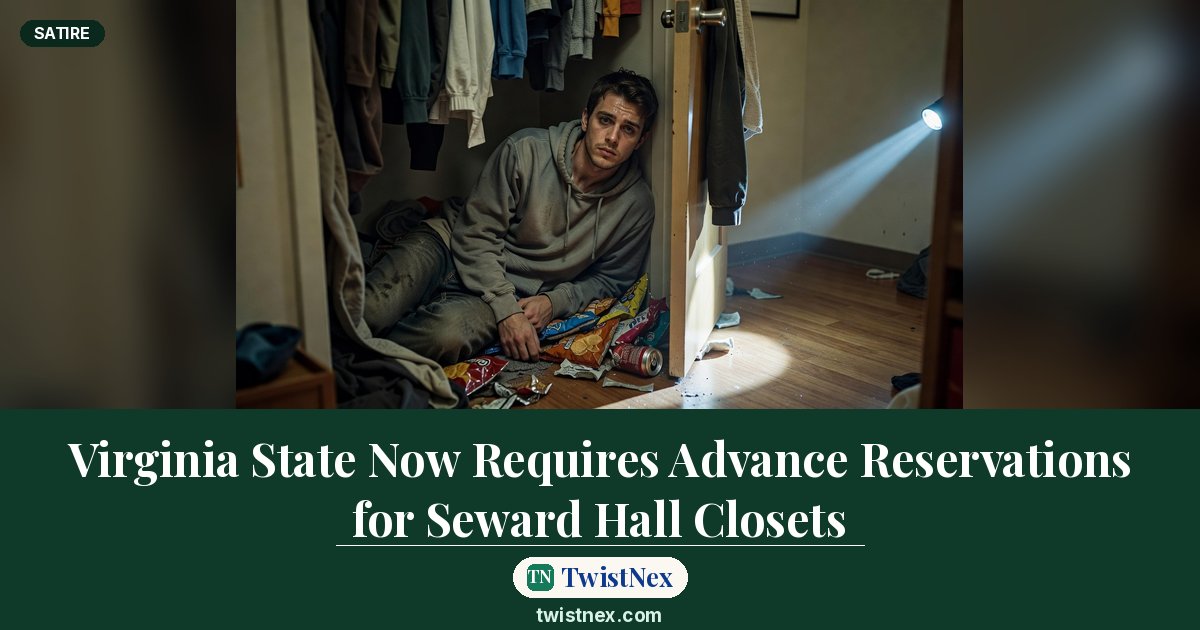
Virginia State University officials confirmed that 19-year-old Camron Harris, who is not a student, spent more than 14 hours wedged inside a Seward Hall closet after the Saturday shooting that left five people injured. Police located him at 4 p.m. using what authorities described as “standard dorm-room search procedures.”
Campus security has already floated plans to add mandatory closet walkthroughs to next year’s freshman orientation. “We’re turning this into a teachable moment,” said a fictional risk-management consultant who requested anonymity and a larger consulting fee. “Students will learn the difference between a good hiding spot and a career-limiting one.”
Multiple other suspects remain at large, according to police, yet early speculation focused on whether they too had simply run out of phone chargers. A university spokesperson, speaking on background, noted that Seward Hall closets now require advance reservations during high-stress periods.
Harris’s decision to remain motionless for half a day while officers cleared the building drew quiet admiration from one unnamed tactical instructor who called it “impressive core strength and zero follow-through.” The same instructor suggested future active-shooter drills include a snack budget so suspects have less incentive to surrender.
Local businesses near campus reported a brief spike in delivery orders placed from unknown numbers, which administrators interpreted as either copycat behavior or unusually thorough meal-plan research. The school has not yet decided whether closet residency will count toward housing credits.
Investigators continue to sort fact from fiction while maintenance crews measure every closet on campus for future compliance posters. Officials insist the exercise is purely preventive and definitely not an attempt to monetize the space as premium single-occupancy housing.