U.S. Downgrades South Korea Drills to Fund Recurring Iran Threat Subscription
Satire: TwistNex is a satirical publication. This is fiction inspired by real news. Quotes, experts and statistics are invented and must not be cited as fact.
Trump cuts joint drills with South Korea then warns Iran of strong action, leaving Seoul to practice self-defense without the usual American props.
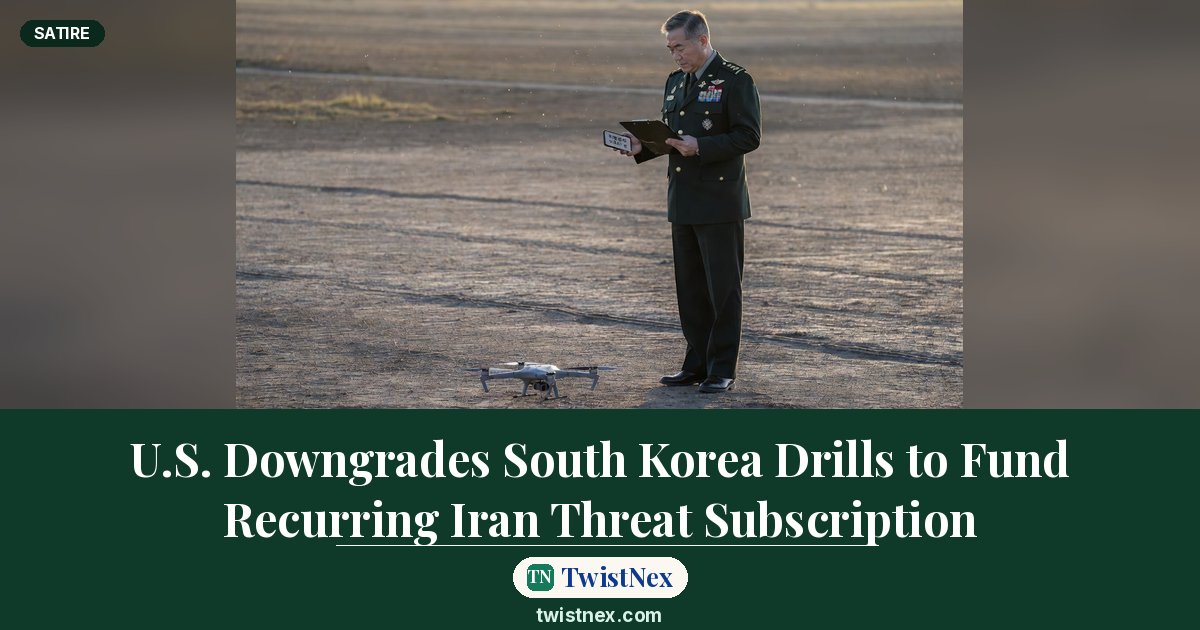
South Korean President Lee announced plans for greater military independence after President Trump ordered joint drills scaled back to focus on Iran. Officials described the move as a long-overdue correction rather than a sudden scramble prompted by an ally's abrupt schedule change.
The decision arrives as Trump warned of "strong military action" if talks with Tehran over the Strait of Hormuz stall. South Korean planners now face the novel task of simulating defense without the usual American aircraft carriers parked offshore for photo opportunities.
A senior defense official, speaking on condition of comedy, claimed the new posture would involve "more local ingredients" and fewer scripted press conferences. Budget analysts quietly updated spreadsheets to reflect the cost of buying equipment previously leased from Washington under the "friends and family" discount.
North Korea's Kim Jong-un, long accustomed to being the dramatic centerpiece of U.S. attention, reportedly received the news with the same enthusiasm as a canceled reality-show cameo. Iranian negotiators, meanwhile, were advised to enjoy the current lull while it lasted.
Critics noted the policy's elegant symmetry: allies told to handle their own business, adversaries told to expect decisive intervention. The result is a foreign-policy doctrine that treats joint exercises like optional team-building exercises and military threats like recurring subscription services. South Korean forces have begun additional training rotations described as "independence practice," a phrase previously reserved for teenagers learning to do their own laundry.