Democrats Confirm Progressive Wins Valid Only in States They Do Not Control
Satire: TwistNex is a satirical publication. This is fiction inspired by real news. Quotes, experts and statistics are invented and must not be cited as fact.
Bernie cheers a Florida progressive upset while Michigan Democrats sprint to prevent the same thing from happening to them.
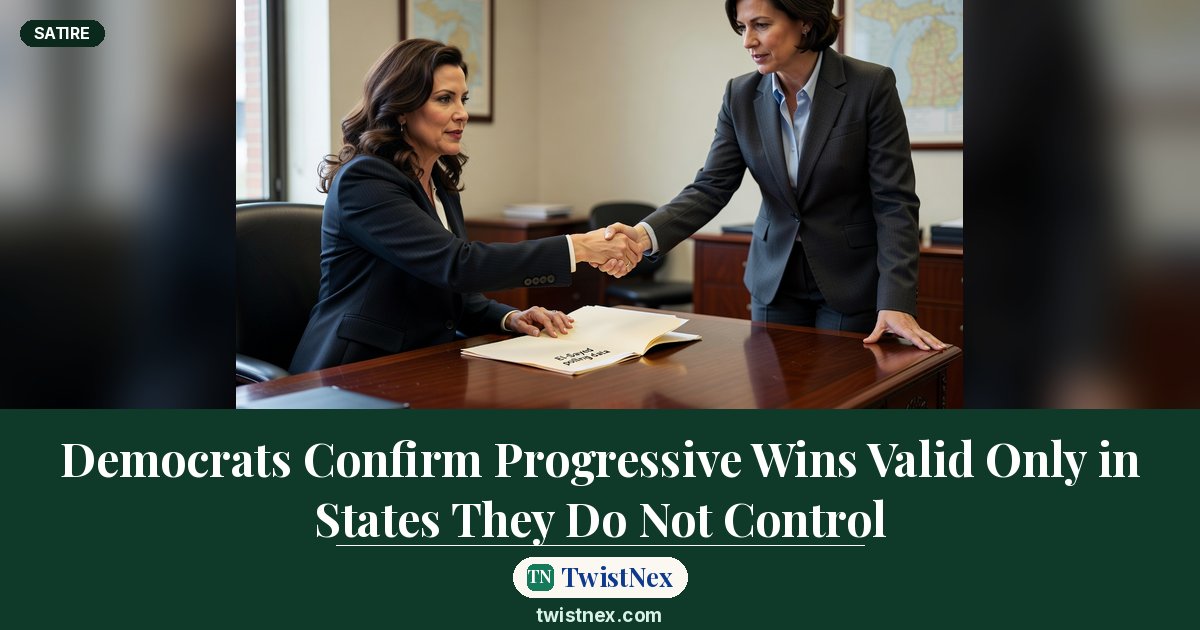
Sen. Bernie Sanders endorsed Florida state Rep. Angie Nixon after she crushed a better-funded opponent, proving that organized people can beat organized money when the organized money forgets to organize properly. Michigan Gov. Gretchen Whitmer responded by endorsing Rep. Haley Stevens over progressive Abdul El-Sayed, citing the urgent need to get things done by people who have already demonstrated they can get very little done.
Party strategists described the Michigan primary as a high-stakes contest between “getting things done” and “getting things that might actually help people done,” a distinction that has apparently required last-minute intervention. Whitmer’s endorsement arrived late, suggesting the decision was reached only after someone noticed El-Sayed polling well enough to make moderate donors spill their oat milk lattes.
The broader strategy appears simple: praise the occasional progressive victory in one state while ensuring no additional progressive victories occur anywhere else. This preserves the party’s long-standing commitment to incremental change measured in decades rather than terms. Analysts noted that voters who want bolder policy can always wait until the next cycle, or the one after that, or perhaps just accept that the current system is working fine for the people already inside it.
Sanders’s endorsement of Nixon was treated as an inspiring example of grassroots power, provided the grassroots stays in Florida and does not attempt any cross-state migration. Meanwhile, Michigan Democrats emphasized electability, a metric that has historically favored candidates who can raise money from the same donors who prefer the status quo remain comfortably quo.
The pattern suggests future primaries will feature similar late endorsements for whichever candidate least resembles the last one who won by accident.