Navy Rates Billion-Dollar Destroyer Mission-Capable After Four Days As Bucket-Only Sauna
Satire: TwistNex is a satirical publication. This is fiction inspired by real news. Quotes, experts and statistics are invented and must not be cited as fact.
US Navy destroyer loses power for four days in South China Sea, leaving sailors without AC, water, or toilets — peak military readiness.
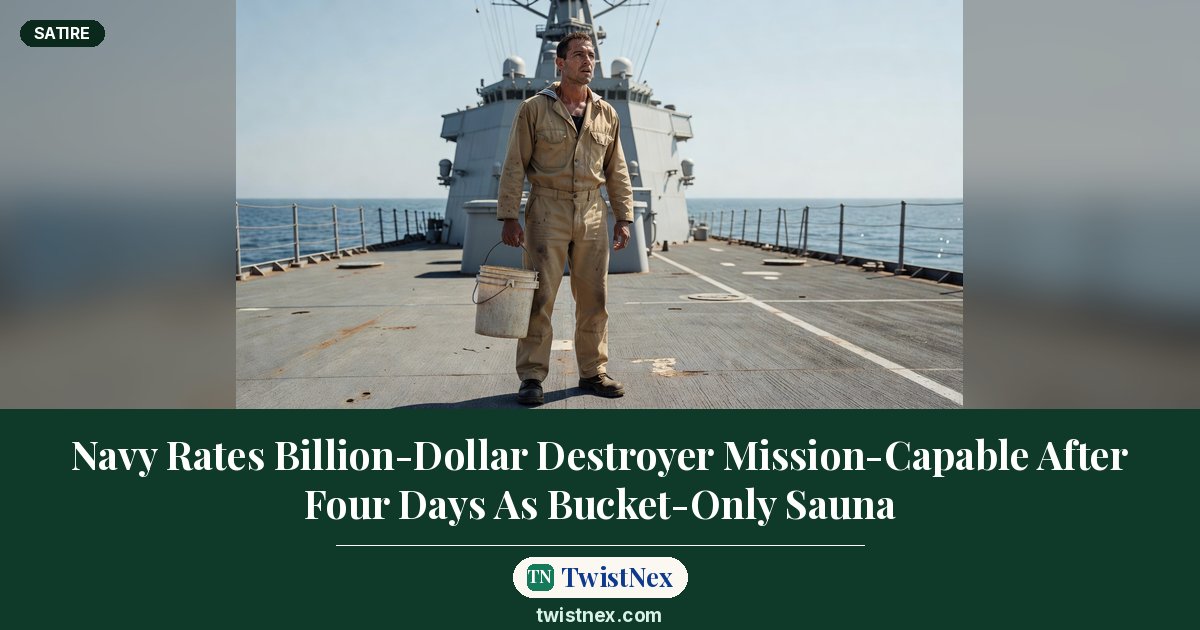
The USS Benfold, an Arleigh Burke-class destroyer built to project American power across the Pacific, instead spent four days adrift in the South China Sea last month after an engineering casualty knocked out everything from propulsion to plumbing. Sailors reportedly endured the ordeal without air conditioning, fresh water, hot meals, or functioning toilets, turning one of the Navy’s most advanced warships into a very expensive, very warm floating porta-potty.
Navy officials described the incident as an isolated “engineering casualty,” which is military-speak for the ship equivalent of a car stalling on the highway while the driver frantically tries to remember how a dipstick works. With no power, the crew reportedly resorted to manual methods for waste management that would make 18th-century pirates nod in grim recognition. One fictional after-action report circulating among sailors claimed the ship’s new standard operating procedure involved “bucket relays and strong core muscles.”
The episode has renewed questions about maintenance strain on the fleet, though Pentagon spokespeople insist the destroyer remains fully mission-capable as long as the mission does not require electricity or dignity. A senior officer, speaking on condition of anonymity, reportedly told subordinates, “Think of it as a surprise resiliency drill. The Chinese won’t expect us to fight while holding our noses.”
Analysts noted that the Benfold was operating with the George Washington carrier strike group at the time, suggesting the Navy’s forward presence now includes forward absence of basic utilities. Budget documents show the ship cost roughly $2 billion to build, which experts say makes it the world’s most expensive demonstration that even guided-missile destroyers occasionally need jumper cables.
In the broader Indo-Pacific context, the four-day blackout has been hailed by some inside the building as proof that American sailors can still operate “old school.” Others quietly wonder whether the next engineering casualty might involve the entire Pacific Fleet discovering that toilet paper is also a supply-chain vulnerability. The Navy has promised a full investigation, which will likely conclude that the best fix is more money and fewer questions.