Ukraine Delays Elections Until All Voter Addresses Still Exist
Satire: TwistNex is a satirical publication. This is fiction inspired by real news. Quotes, experts and statistics are invented and must not be cited as fact.
Zelensky warns that letting Ukrainians vote right now could break the country, so the safest move is to keep everything exactly as it is.
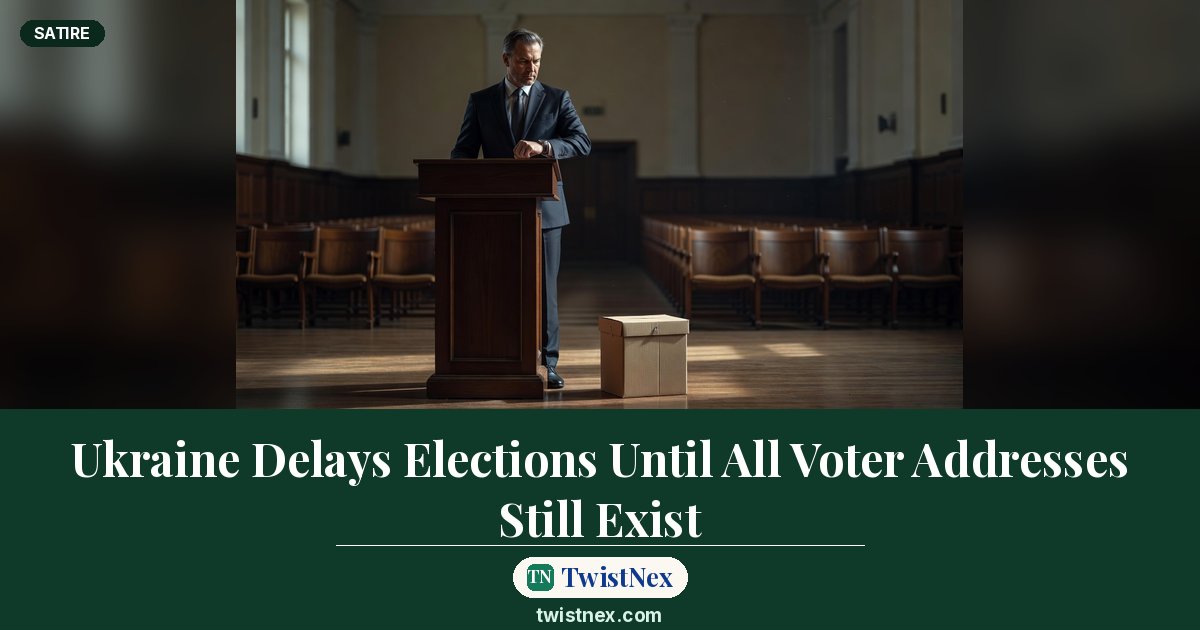
Ukrainian President Volodymyr Zelensky warned Sunday that holding elections during the ongoing war with Russia would risk splitting the country and destroying its unity. He described the process as carrying "major risks" that no responsible leader could ignore.
The logic appears straightforward: ballots require stable infrastructure, safe polling stations, and a population not actively dodging missiles. Introducing competition now, officials argue, could fracture the national consensus that has so far kept the government intact. Critics calling for a vote are reminded that democracy works best when nobody is actually fighting.
A senior adviser, speaking on condition of anonymity because transparency is also risky, explained the math. "We modeled turnout under artillery fire," he said. "The projections showed voter turnout at roughly 12 percent, with 40 percent of those voters still registered at addresses that no longer exist. That is not a mandate; that is a logistical nightmare."
Independent analysts at the Center for Hypothetical Governance noted similar patterns elsewhere. Leaders facing prolonged conflicts often discover that postponing elections preserves stability until a more convenient moment arrives, typically after retirement or victory. One model predicted Ukraine might achieve ideal election conditions around 2039, assuming current trends in reconstruction and ceasefire negotiations continue at their present pace.
Zelensky emphasized that the decision protects the country rather than any individual. "If we want to destroy the country, then we can move towards elections," he told reporters. Observers interpreted the statement as a firm commitment to not destroying the country, at least not through voting.
Opposition figures have countered that prolonged one-man rule carries its own risks, but those concerns are currently classified as secondary to the primary goal of national survival. Polling data remains unavailable, largely because no one has attempted to conduct any.