GOP Plans to Blame Democrats for Turnout Drop Caused by Its Own Mail Ballot Limits
Satire: TwistNex is a satirical publication. This is fiction inspired by real news. Quotes, experts and statistics are invented and must not be cited as fact.
Trump’s mail-in crackdown quietly targets the voters who mail in the most—his own.
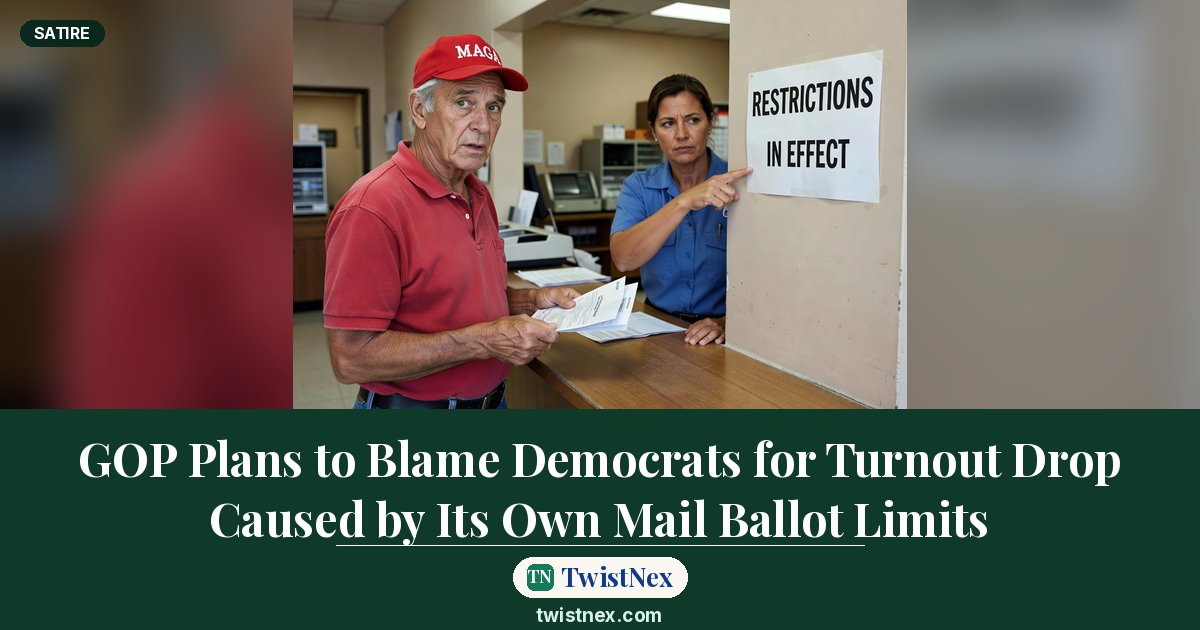
President Trump’s executive order tightening mail-in ballot rules has produced an unexpected casualty: Republican voters. Election law experts now project that the restrictions will suppress turnout among the party’s most reliable demographic—older Americans who have long treated absentee voting as a sacred convenience rather than a suspicious loophole.
One senior GOP strategist, speaking on condition of anonymity and several layers of plausible deniability, described the development as “a bold strategic choice to make our base work harder for the privilege of supporting us.” The strategist added that the party remains confident it can offset any losses by loudly accusing Democrats of the exact policy it just enacted.
Black voters, meanwhile, have signaled they are prepared to make noise over newly drawn maps already labeled “Jim Crow 2.0” in certain Republican-led states. Party officials insist the maps are merely “community-informed” and that any resemblance to historical suppression tactics is purely coincidental and also the media’s fault.
Inside Republican circles, the emerging plan appears to be a two-track approach: restrict mail ballots while simultaneously warning that any resulting low turnout proves the other side is cheating. Early internal polling obtained by no one shows this message testing well among voters who enjoy both limited options and unlimited excuses.
A fictional advisory memo circulating among state party chairs suggests members simply stop referring to mail-in voting as “easy” and start calling it “the kind of laziness that real patriots reject—except when it’s convenient for us.” The memo was immediately disavowed by everyone who helped write it.
Observers expect the coming weeks to feature robust congressional hearings in which lawmakers express surprise that policies they championed might affect the people who elected them. Until then, both parties are advised to keep accusing each other of the same thing while insisting only one side means it.