Maine Candidate Requests ICE at Polls to Deter Non-Citizen Voting That Has Never Occurred
Satire: TwistNex is a satirical publication. This is fiction inspired by real news. Quotes, experts and statistics are invented and must not be cited as fact.
Maine Republican wants ICE guarding ballot boxes while Elon Musk funds the turnout drive that apparently needs that kind of security.
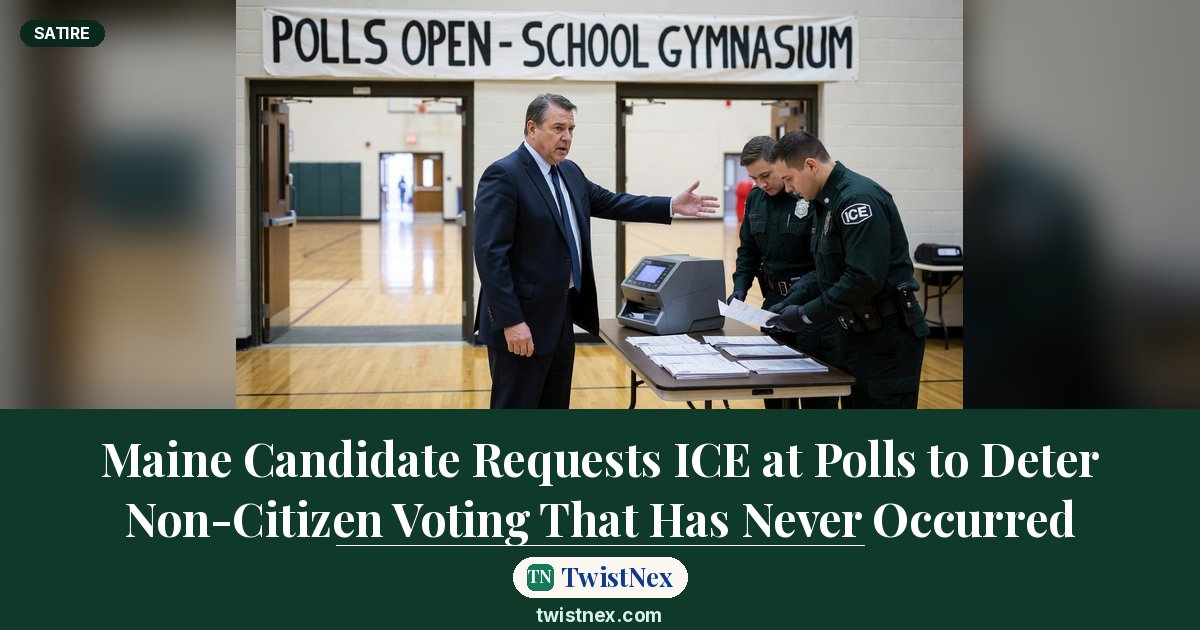
Bobby Charles, the Republican nominee for Maine governor, has asked the Trump administration to send Immigration and Customs Enforcement officers and U.S. Marshals to every polling site in the state ahead of the midterms. He reportedly plans to route the request through White House border czar Tom Homan, treating voter lines like a stretch of the southern border that needs tactical oversight.
Charles framed the deployment as basic security, arguing that polling places require federal muscle to prevent non-citizens from casting ballots. No evidence of widespread non-citizen voting has surfaced in Maine, but the request treats the possibility as urgent enough to justify agents with detention authority standing beside voting machines.
Elon Musk’s America PAC, fresh off spending more than $260 million on the last cycle, is simultaneously preparing a large get-out-the-vote operation aimed at boosting Republican turnout. The dual-track effort creates an unusual division of labor: Musk’s network focuses on encouraging citizens to vote, while Charles’s plan stations enforcement personnel to monitor who shows up.
Campaign observers noted the setup could produce striking visuals at rural Maine community centers. One imagined scene involved an ICE vehicle parked next to a bake-sale table selling whoopie pies for the local school board. Another predicted Marshals reviewing voter rolls while Musk’s digital team texted reminders about early voting hours.
Charles has not detailed how many agents he considers necessary or what training they would receive on Maine election law. Homan’s office has not confirmed whether the request will be granted, though the administration has shown openness to creative uses of federal personnel. Musk, meanwhile, continues to position his spending as essential to rescuing Republican prospects despite the president’s polling numbers.
The combined approach leaves little doubt that both the candidate and the donor view the midterms as requiring extraordinary outside help. Whether that help arrives in the form of canvassers or federal badges remains the only open question.