Roman Telescope Locates Habitable Planet, Immediately Restricts Data to Internal Servers
Satire: TwistNex is a satirical publication. This is fiction inspired by real news. Quotes, experts and statistics are invented and must not be cited as fact.
NASA’s new telescope is heading to space specifically to avoid watching us.
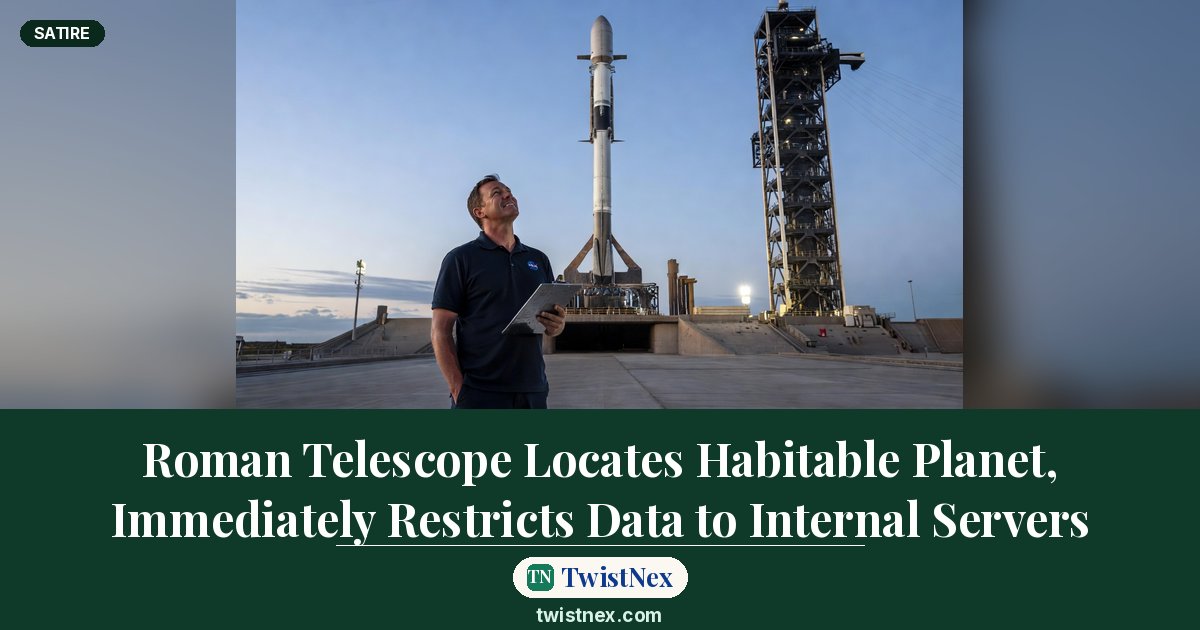
NASA and SpaceX rolled the Nancy Grace Roman Space Telescope out to the pad this weekend, strapping it to a Falcon Heavy so it can finally study dark energy, exoplanets, and anything else that does not involve scrolling through launch commentary.
Officials insist the mission will deliver the clearest pictures yet of the universe’s expansion. Early test data already suggest the telescope’s first priority will be locating planets where no one is live-tweeting rocket delays or arguing about payload fairings.
Engineers described the instrument as “remarkably stable” once removed from Earth’s information environment. One simulation showed the telescope locating a potentially habitable world within months, then immediately requesting its data feed be routed only through internal servers with no comment sections.
SpaceX noted the Falcon Heavy’s extra lift capacity will allow the observatory to carry additional shielding against both radiation and unsolicited opinions. NASA added that the telescope’s wide-field camera will operate continuously, provided no one forwards it trending hashtags from the pad.
Astronomers expect the first images to arrive in 2027. By then, mission control hopes the telescope will have identified enough distant galaxies to justify never returning calls about terrestrial headlines again.