Industry Analysts Hail Tunnel Survivors as 'Statistically Convenient' Outcome
Satire: TwistNex is a satirical publication. This is fiction inspired by real news. Quotes, experts and statistics are invented and must not be cited as fact.
Nine days underground and the only thing more impressive than the rescue is the company still calling the tunnel 'state of the art.'
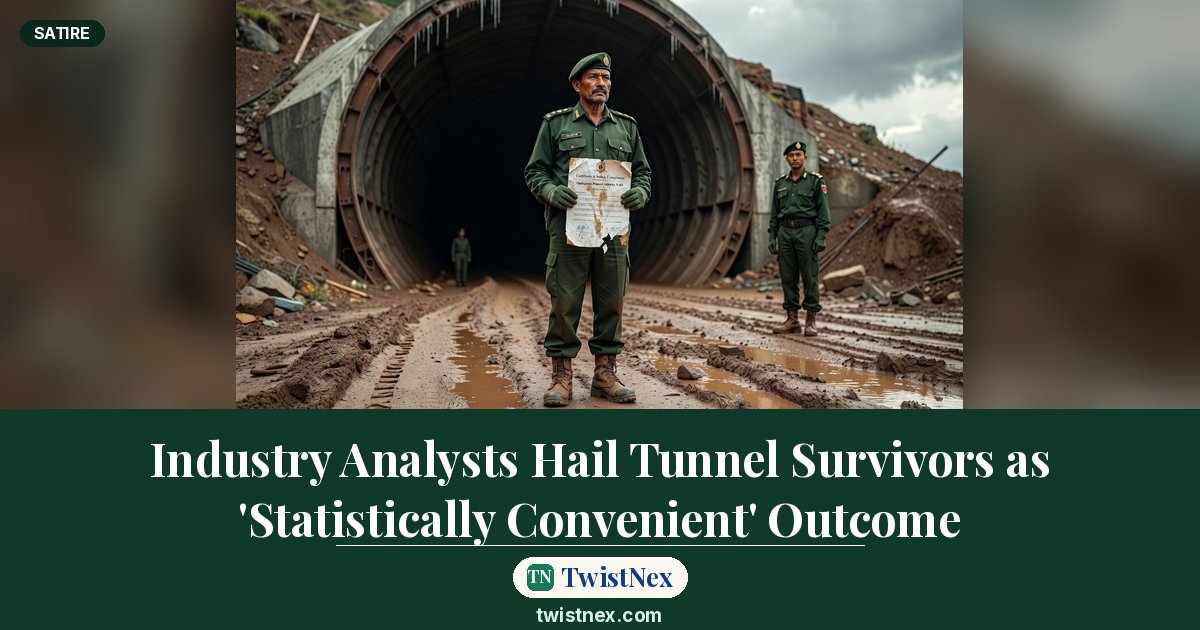
Rescue teams in Nepal have confirmed that two workers survived nine days trapped inside a hydropower tunnel after last week’s floods, a development industry analysts are already calling “statistically convenient.”
Officials from the Trishuli 3A project described the outcome as a testament to modern engineering, noting that the 170-metre depth provided “excellent natural climate control” until the mud arrived. A company spokesperson added that the survivors’ continued employment status remains under review pending their ability to file the required overtime forms.
Military personnel and South Korean specialists who conducted the extraction declined to comment on why the same tunnels had been declared structurally sound just weeks earlier. One unnamed officer reportedly muttered that the real miracle was finding anyone still willing to work at the site.
Economists tracking Nepal-China infrastructure deals have pointed out that the projects continue to attract funding despite repeated flood warnings, largely because the fine print defines “force majeure” as anything that actually happens. A regional development bank report, leaked to no one’s surprise, concluded that worker resilience remains the most reliable safety feature.
The rescued Chinese man and Nepali woman are expected to receive standard hazard pay along with complimentary commemorative hard hats that double as flotation devices. Project managers have already scheduled a press event to highlight how the incident demonstrates “the durability of cross-border cooperation,” provided the border stays above water.
Observers note that rescue operations are now being used as performance metrics for future loans, with one consultant suggesting that survival rates could be improved simply by not building in flood zones. Company spokespeople countered that such suggestions lack the necessary optimism required for quarterly reporting.